
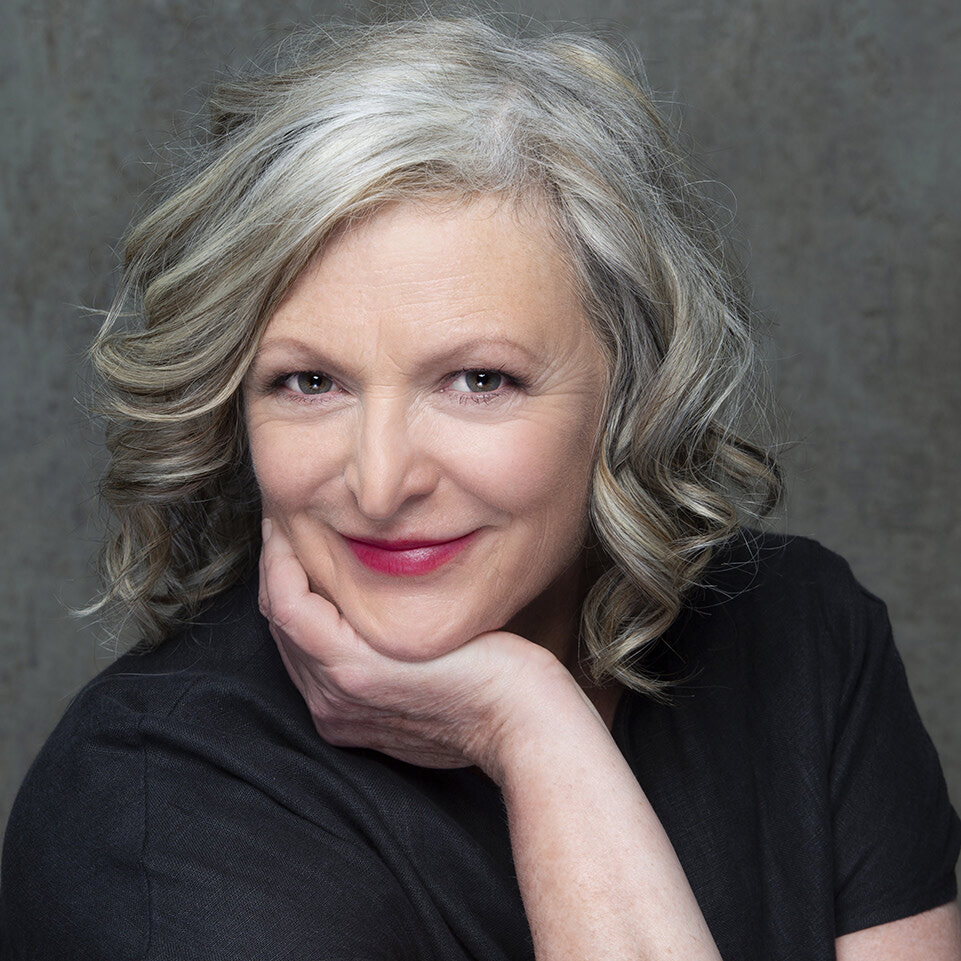
BF26: Kelly McIntosh delves into history with 'Curveball'
BY SCOTT STEPHENSON
Some multi-hyphenates are just a little more “multi” than the rest, and Kelly McIntosh is one such artist.
Actor. Collaborative playwright. Managing director of the Stratford Perth Museum. Pioneer of equestrian theatre. The list goes on. And while there’s nothing in the rulebook that says a horse can’t play baseball, McIntosh’s new show, Curveball: The Fast-Pitch Ladies of the Factory Floor, leaves the world of avant-equine theatre behind in favour of a sporty musical with more than a little mustard on it.
Curveball is a new musical born of the inspiring true story of the Kroehler Girls - Stratford’s very own pioneers of Canadian women’s baseball. McIntosh has written this show in collaboration with Andy Pogson, Stacy Smith and Severn Thompson, with music by Dayna Manning. Thompson is also pulling double duty as the director of Curveball.
While creating this show has certainly turned into a team sport, McIntosh’s latest return to Blyth was initially inspired by a single image. “It’s so often a photograph for me,” she told The Citizen. “The first part of the development of Curveball happened here in the Stratford Perth Museum. I was working at the museum part-time with the former museum director, and I saw in the historic kitchen a photo of two women. It was the 1950s - you could tell from their haircuts. I saw the looks on their faces, and I thought, ‘There’s something happening here’. And then, very quickly, I discovered that this women’s baseball team that came out of the war really meant a lot to people. They, you know, they led the parades. They were phenomenal.”
After seeing that photograph, McIntosh was inspired to begin collecting stories about the Kroehler Girls through direct engagement with local people, which, years later, would eventually evolve into a series of well-attended ‘community conversations’ at the museum. “People came, and shared more stories, and we read and acted out some of the scenes that are in the show,” she explained. “If people are interested in a story, they feel a part of it… People love to time travel. They love to go back to an era of time that either they lived through and can remember, or that they didn’t live through, but they want to see what it might be, might have been like then. And they learn more about their mothers and their parents or their grandparents.”
The story itself sits at a fascinating historical crossroads. “There’s still living history with this story, because it took place in the early 1950s. They were called the Kroehler Mosquitoes during the war,” McIntosh said. “Once you start looking at that period of time coming out of the war, you really see how the world changed so drastically in the 1950s. What is this new world? Where is everybody’s place in it?”
For the Kroehler Girls, the 1950s was also a time of unprecedented possibilities. “There was an idea that they could actually have a professional paid career in baseball - and that was unique for women,” McIntosh pointed out.
The show has evolved significantly since it was first staged in 2021 as Kroehler Girls!, starring McIntosh, Smith and Pogson in all of the primary roles. The pandemic-era show was originally performed outdoors, on the very field where the team once played.
Now, Kroehler Girls! has evolved from a piece of stripped-down necessity theatre into a big, bold musical for the Blyth Festival’s 2026 season. The show is being created collaboratively by the entire writing team, with Manning’s musical brilliance driving the whole thing to new heights. “It’s not always easy to collaborate,” McIntosh confessed. “We all have our own ideas of what something should be, so you’re constantly in a state of humility, but also, you get to watch your collaborators come up with this amazing stuff. In this Curveball situation, I’d say that all of our DNA is on every scene, and every character. We’ve largely forgotten whose idea was what… and Dayna Manning’s music is just ridiculous. It’s beautiful, and she’s able to swing from heartfelt songs into a hilarious scene.”
While her career tends to move fluidly across complementary disciplines, one thread has remained constant: the desire to tell community-driven stories. It’s a desire that has brought McIntosh back to Blyth time and again.
Her long-term relationship with the village of Blyth began in 1998, after catching the eye of Paul Thompson while working in British Columbia at the Caravan Farm Theatre. “When I came to Blyth, I had no idea that I was going to go to sort of another level with connecting with the community who would actually come to see the shows,” McIntosh told The Citizen.
Her introduction to Blyth was both immediate and memorable. “Paul Thompson was a really strong proponent of getting to know the locals, getting to know your neighbourhood,” she recalled. “I remember arriving, and the first thing he did was take me around to somebody’s farm - they were growing garlic. And, when we rehearsed Death of a Hired Man, it was at the end of the season, so it was during [the annual Thresher Reunion in Blyth], and so the garlic was ready, and he bought this huge bag of garlic.”
That first impression has always stuck with her. “I remember the quality of the light,” she recollected. “I remember the quality of the light - there’s nothing like the quality of the light in Huron County… I just felt like I was at the edge of the world in such a magical place.”
That strong sense of place would become central to McIntosh’s work at the Blyth Festival, particularly during her time in The Outdoor Donnellys, where her background working with horses proved handy. “One of the reasons Paul was excited to work with me originally was because I worked a lot with horses at the Caravan Farm Theatre - I knew a little bit about teams, and I knew how to harness, and stuff like that,” she explained to The Citizen. “We were trying to stage a press photo for The Outdoor Donnellys, and they wanted to capture the horses, and Eric Coates up on the stagecoach. And I said, ‘well, I know those horses - I trust them - why don’t we do a thing where I’m running, and Will Donnelly is chasing me? I feel safe about that.’ And so we staged it, and we did it. I don’t even know if it was a moment in the show yet, but I was running, and the horses were chasing me. I jumped up on the stage, Eric jumped off the stagecoach onto the stage. It was really very cinematic.”
That press photo would go on to take on a life of its own. “I felt so proud of what we were doing, and how special it was. What I most remember is when Eric came into The Boot, holding the London Free Press, and that photo was on the cover. And he threw it down, and he said, ‘All of our lives are gonna change’… or something like that. And in that theatre micro-way - it did,” McIntosh said. “At the time, you don’t know that something is going to catch fire in the way that The Outdoor Donnellys show did, and that it would be done again and again. I ended up winning an award for my work on that show.”
Looking back, McIntosh now sees that moment in Blyth as a formative part of her creative development. “Now that I’m old and gray - you don’t know when these moments are going to come, and you don’t know that they might never come again,” she advised. “That’s why that moment really stands out as being the kind of moment that, for me, cemented in my soul the kind of theatre that I wanted to do - I wanted to do shows where people felt a part of it.”
Returning to Blyth now feels less like a visit and more like a homecoming. “I can’t believe I get to go back to Blyth. It’s really a creative home for me, and I am just so grateful to be back,” she said. “And it’s so great to be outdoors on the Harvest Stage. We’re going to get to see the sun go down, and those lights come up, just when things are the most dramatic for the Kroehler girls.”
For an artist whose work has always been rooted in place, people and shared experience, it’s a fitting stage.