
Blyth CRC renovations complete, congregation aims to welcome community
BY SCOTT STEPHENSON
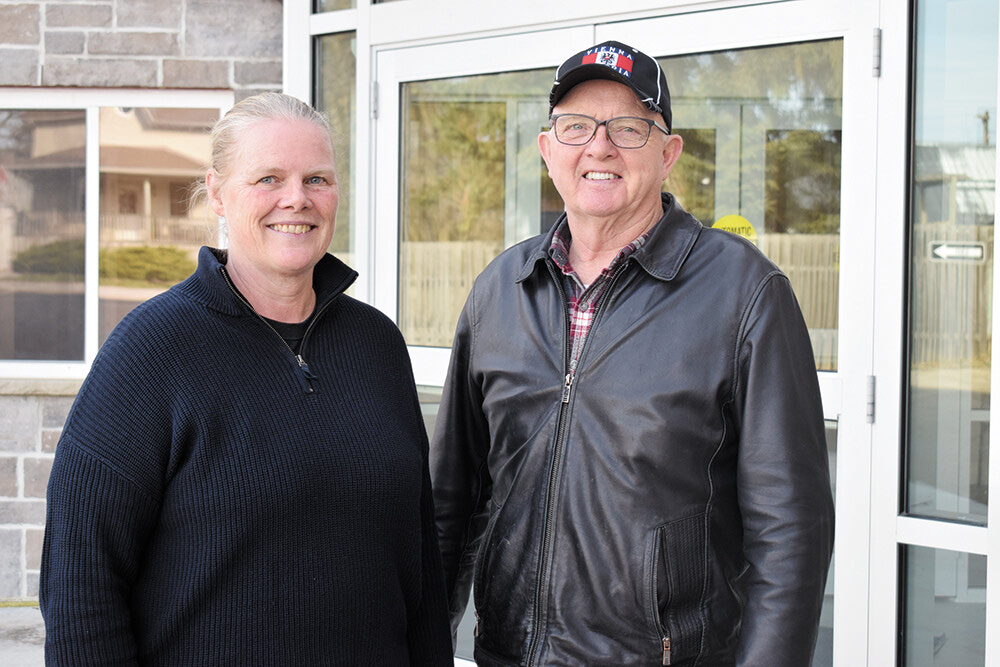
After eight years of steady work, the Blyth Christian Reformed Church (BCRC) on Queen Street has completed a major renovation project. To celebrate, the congregation is inviting the entire community to an open house on Dec. 14 from 2-4 p.m., giving residents a chance to see how faith, planning and hard work have shaped an expansion designed to serve future generations. Ahead of the event, Project Manager Luke Bouman and Council Vice-Chair Audrey Bos kindly offered The Citizen a sneak preview of the renewed space.
It’s been 128 years since the cornerstones of the stately church at 345 Queen Street were first laid. Built originally as a Methodist church, the building has served several denominations over its lifetime. Since the early 1960s, it has been home to the BCRC. Over the years, the church has gradually been adapted and reshapen to meet the needs of a changing rural community.
Long harboured dreams of improving their facilities began crystallizing into a reality in 2017. “We had a formal meeting with a long-term visioning process,” Bouman explained. “We discovered that we needed some more facilities to be able to accommodate some of the kids from town to participate in some of the boys’ programs and girls’ programs. We had no facilities for storage of any sort, and our nursery needed updating to accommodate current safe church policies. And so the conclusion was that we were going to build a new piece on.”
The plan was to create flexible rooms that would serve both present and future needs. A new social room to serve the congregation and wider community was part of the vision, along with expanded classrooms on a new second floor, extra storage space in the basement and a dedicated room for the cadets/Boys Club. Seasonal items such as the Christmas display now have a proper home in the shed.
As the BCRC’s Chair of the Deacons, Bos brought a unique perspective to the project. “I look after the physical needs of our congregational people in the community,” she said. “And I’m retired, so I had time!”
Meeting practical needs was a major guiding principle for the project from the outset. “We have a lot of young families with parents in their late twenties and early thirties… the intent is to plan for the future,” Bos pointed out. Currently, the congregation includes children of all ages. “Having the cadet room means we can have more kids working on long-term projects,” she explained. “The cadets used to have to work in the fellowship hall, and by the time they dragged everything out and got going, it was 8:30 and they had to start packing up again for nine o’clock. Now they can just leave everything set up. And the nursery is now just so welcoming for young families.”
Also paramount to the project: increasing the floorspace of the busy church. “We have additional classrooms upstairs,” Bos told The Citizen. “Before, classrooms were tight. We didn’t have a lot of space, and they weren’t nice rooms.”
The large multipurpose room is another new space to explore. “It’s not settled yet, but I can see movie nights happening there, with that big TV,” she said. “There are more options for kids to hang out.”
Of course, there are some things that just don’t need a modern touch. “The sanctuary upstairs, we haven’t touched,” Bos assured. “It is architecturally spectacular. The acoustics in there, if you’re a singer, are phenomenal. And we are a singing congregation.”
The path to completed construction has been a long and winding one, full of both patience and providential surprises. “Over the years, this church has purchased various lots,” Bouman explained. Originally, it was a very narrow, long lot with a little bit of parking behind. Then we bought this lot, and then we bought the bus storage building, the bus depot. Then the house behind came for sale, and we bought that, and never did much with it for probably 15 or 20 years.”
When applying for a building permit in 2017, the church learned that its collection of parcels would need to be amalgamated. Bouman recalled, “There was a whole process in that… believe it or not, there was a small chunk of property that was ‘No Man’s Land’, right in the middle of the parking lot; the last person of title on that was from 1926. So they had to advertise for anybody to come forward, and then we ended up with squatters’ rights.”
A previously unknown strip of municipal land also emerged. “Nobody knew about this stuff,” Bouman pointed out. “It’s kind of funny. And frustrating, for sure.”
The project was initially budgeted at $650,000, including a 10 per cent contingency. “Things change,” he said. “We voted that we had to have 55 per cent of that upfront, either in pledges or in cash, before we could get started. This project never had to get a mortgage. There was enough money to pay for everything as we went.”
Amalgamation took a year and a half, concluding just as the COVID-19 pandemic complicated construction across the province. Costs fluctuated, and engineers were scarce. Bouman stepped in as project manager. “‘I looked after it, with a really qualified team,” he said. “We have a lot of contractors in the congregation. There’s a cement guy in the group, we have a finishing carpenter guy in the group, we’ve got a framer in the group… we kind of had all of our angles covered! I don’t have any construction experience, so I just co-ordinated it.”
The work itself strengthened the bonds within the congregation. “It was a really neat project; one of the goals is to keep the congregation tied together, by volunteering and working together,” Bouman said. “And that worked out really well.” Bos agreed, saying, “On the days that I did painting, it was with people I didn’t really know that well. So you’re working, but you’re also chatting a little bit. You learn things about somebody on your lunch break.”
Just two weeks ago, the Facilities Planning Committee was finally dissolved. “We’re pretty fortunate that we hung in and stuck it all out together,” Bouman joked. “We’re absolutely delighted with how everything turned out. There are no regrets on any side of it.”
Bos highlighted how the new design supports the church’s calling to be hospitable. “Architecture has to be welcoming. I love the entrance now, because before nobody knew what door to use. Nobody knew where to go,” she said. “As soon as you feel welcomed physically, and then you’re welcomed by greeters, suddenly you’re welcomed by both the space and the people. I just think the way it’s designed will create community with visitors. Hopefully they stay, because they feel welcome coming back. Making things welcoming creates a space where people are more comfortable investigating their faith.”
With the construction complete, the congregation now enters a new phase of discernment and adaptation. “Our thing now is those new patterns of use,” Bos said. “Even just this Sunday morning, I thought, ‘Why am I not using that big comfortable room for catechism?’”
Bouman noted that change also requires inward work. “For some of us, we’ve got to change our mindset a bit. We’re used to this being our gig, our thing. And we’re comfortable with that. But we’ve got to get outside of what we’re comfortable with.”
He emphasized that the renewed building is for the whole village, not only its members. “I want to stress the fact that this is not a members-only church. People from the community are more than welcome to come for a worship service. We’re hoping the community will use the space. We want to be part of the community, not just a church in the community.”