
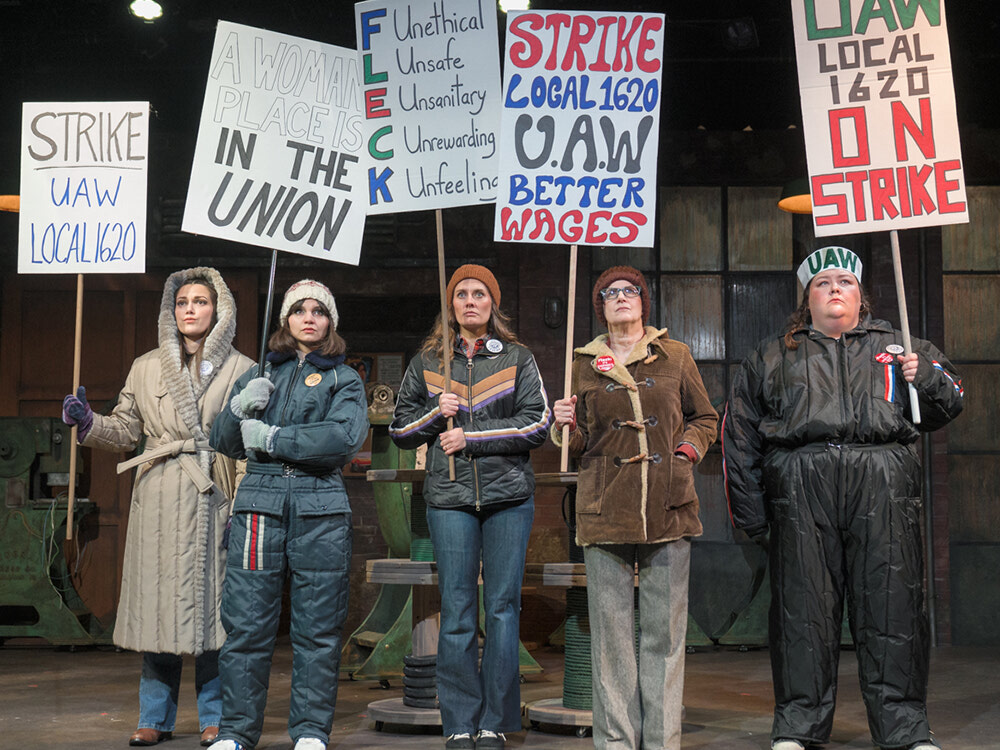
Blyth Festival's 'Sisters of '78' sees newcomers shine in local milestone tale
BY SHAWN LOUGHLIN
It is, perhaps, fitting that, on the same day the Blyth Festival premiered Sisters of ’78, the world crowned its first-ever trillionaire.
The SpaceX IPO (initial public offering) saw share prices soar beyond expectations. The set price of $135 per share would have made owner Elon Musk a trillionaire, but the closing price of $160.95 left no doubt, leaving Musk’s wealth behind the GDPs of just 19 of the countries of the world.
Conversations about workers’ rights, exploitation, the power gap between the haves and the have-nots and the upper class disregarding the working classes are as active as they’ve been in decades, so we turn to a success story from the late 1970s for hope and to remember what can be accomplished when we all work together in the face of what feels like insurmountable oppression.
On the topic of oppression, absent from these paragraphs thus far is the gender aspect of Sisters of ’78, as those seeking to better their station in life are women, based on the real-life women of Fleck Manufacturing. They worked at the auto wiring plant in Huron Park and, in 1978, 80 of them walked off a job that came with concerns with sanitation, accusations of sexual harassment and unsafe working conditions that led one local doctor to refer to the factory as “The Butcher Shop”.
The real-life stories are now legend, as the Fleck strike became one of the longest and most impactful labour movements in this country’s history. It had a particular impact on women’s rights in the workplace - indeed, the year after the strike, some of the Fleck strikers led Toronto’s International Women’s Day parade.
This is the story told by playwright Kristen Da Silva and director Mary Francis Moore, who is the artistic director of Hamilton’s Theatre Aquarius, where the play will be staged later this year. Doing the heavy lifting is a tremendous cast of mostly newcomers to the Blyth Festival. Among Aiden Altow, Shelayna Christante, Madison Hayes-Crook, Cara Hunter, Alyssa LeClair, Geoffrey Pounsett, Kirstyn Russelle and Shaina Silver-Baird, just Christante has been in Blyth before for two previous seasons.
The set design, sound and props work hard to set the scene. We are transported back to the late 1970s, whether it’s the music (the Andy Gibb heads finally have their day in the sun), the clothes, the stubby beer bottles or the cigarettes, it’s not hard to suspend disbelief. The technical crews also deserve kudos for having real (or at least very real-looking) factory machinery on stage, adding to the realism of the set that harkens back to Paul Thompson’s Death of the Hired Man in 2000 that featured an operational threshing machine on stage.
The acting is top-notch, led by a break-out performance from LeClair, who plays Joyce, the employee who is most keen to form a union to lift the workers out of their circumstances. She shines both comedically and dramatically, all culminating with a stirring monologue during the Fleck strike in the second act of the show that elicited applause and cheers on opening night.
Hayes-Crook is our protagonist, Maeve, who is the newcomer to the factory, Russelle’s Natalie is the veteran, Christante’s Angie is the young one and Silver-Baird is Laurie, the supervisor. Altow plays Andrew, Maeve’s husband, Hunter plays his mother, Margaret, and Pounsett plays “Lumpy”, the factory boss, though notably not the owner.
Sisters of ’78, in a way, is the perfect Blyth Festival play. It tells an often-overlooked tale from local history that had an outsized impact on the province and the country. It is a story that is not so dissimilar from the Blyth Festival’s story. However, it is this reviewer’s opinion that we need more “strike” in the strike play.
The first act sets up the poor working conditions at Fleck and its checkered history regarding workers who have come and gone with varying degrees of support from the company. It also gives us the complicated home life of Maeve and Andrew, who is on the road training for the RCMP, while Maeve is home with their daughter and Margaret, when she decides she wants to earn some money of her own.
While Altow, Hayes-Crook and Hunter are all good in what they’re asked to do, I feel the strained relationship and misogyny and abuse at home, though important, takes us too far off of the highway (the Fleck story) too often, and that the same story could have been told more efficiently. Despite being the “humanizing” aspect of the play, it is told largely through long-distance phone calls with Andrew and Maeve who are rarely in the same time zone, making it even tougher for the humanity to hit home with audiences. Every time we left the factory for the home, for me, the play lost momentum.
It’s also 10 or 15 minutes into the second act until the women finally go on strike, which feels like far too much set-up for a play that has been sold on its foundation of an era-defining labour action. The focus of the play is the strike and its impact on those involved and the world of labour relations at large and too often that feels as though it’s not the case.
Having said that, when the women are on strike and detailing the lengths to which they had to go to stand up for themselves in the face of illegal and aggressive union-busting tactics and dirty political pool, the play is on fire. The audience was engaged and cheering, singing the songs with the actors and celebrating the victories along the way. Any time we’re away from the picket line, the telling of this fascinating and important story suffers.
Sisters of ’78 is a rousing, prescient and celebratory telling of a local story that has, for years, needed a bigger stage. And yet, one can’t but wonder what could have been had the focus been narrowed and more time been spent on the main event.
The show is on the Memorial Hall stage until it closes on Sunday, Aug. 9.