
Blyth native leads historic orchestra at Vancouver's Unison Festival
BY SHAWN LOUGHLIN
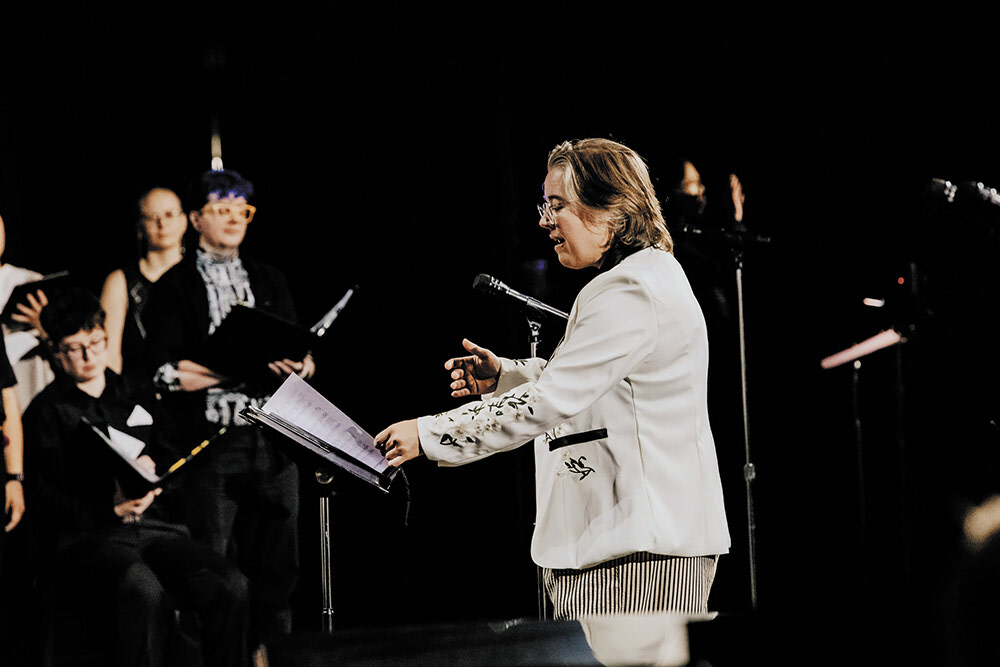
Blyth native Jackie Falconer - alongside over 100 of her closest friends - made history at the Unison Festival in Vancouver as she led Unison Choruses Canada’s first-ever two-spirit, trans, non-binary (2STNB) Festival Ensemble to much fanfare.
The festival, which is held every four years, was last in Halifax. It was there that Falconer was presented with the organization’s first-ever Unison Innovation Award for her creation of the Trans and Non-Binary Ensemble, a complementary choir to Singing Out, Toronto’s 2SLGBTQQIA+ Choir. Falconer is a long-time performer in her own right and has, in recent years, focused her attention on being a choral conductor and voice educator, working her way up to the position of assistant artistic director of Singing Out, a position she has held since 2019.
After winning the Unison Innovation Award in Halifax (that event was held later in the four-year cycle than usual due to the COVID-19 pandemic), she was asked to lead the first-ever national 2STNB ensemble when the group convened again in 2026 in Vancouver. Speaking to The Citizen last September, Falconer said that being asked to be a part of history in this way was a tremendous honour.
Falconer saw the potential for such a group early in creating the Trans and Non-Binary Ensemble in Toronto and her innovation has continued to foster growth not just in Toronto, but across the country. “I saw a space for something new to exist here that had been lacking in the past and made it happen. Our ensemble performed at the festival to rousing standing ovations. The need for this kind of art space is clear and their excellence only propels us to keep going,” she said to The Citizen last September.
As for this year’s festival, Falconer said that the lion’s share of the participants came from Singing Out and the Toronto area. However, once in Vancouver, they were able to join up with participants from around the country to bring together over 100 voices. She said that the event featured 27 choirs, which is an astounding level of growth. There were 16 in Halifax just a few years earlier at an event that began as a grassroots effort to bring choirs featuring members of the 2SLGBTQQIA+ community together with literally just a handful of choirs in those early years.
Falconer said she had a great time at the festival and that it was amazing to see so many like-minded individuals together with a shared goal. However, much of her focus was on the practical aspect of the gathering, which was the task at hand of directing the ensemble on a very tight timeline.
She had two full rehearsals with the group before their festival-closing performance, so Falconer knew that she and her singers had to make the most of the time they had together.
The performance, of course, was fantastic and met with a warm and enthusiastic response from those in attendance, Falconer said. The song that ended the performance and, indeed, the festival itself, was a stirring rendition of “They Cannot Erase Us”, which, Falconer said, served as somewhat of a rallying cry for the entire festival and its attendants. With many in the world taking a sharp rightward turn in regards to transgender rights and acceptance, the song had so much meaning in that room and was the message the community needed to send in this moment in time.
She also noted that there had been discussions among the group at the festival about inclusion and acceptance in their home communities that made the ensemble’s message resonate with those in attendance. Members of the ensemble had come from the U.S. and some of the more conservative Canadian provinces and are having to fight for their rights on a daily basis, facing barriers and opposition to being who they are, so it was clear that this was a meaningful message not just for those who were there to witness the performance, but by those who were giving it as well.
Falconer said that she couldn’t have been more pleased, from her perspective, with how well the festival went. Seeing a relatively small project she started in Toronto a few years ago blossom into over 100 people singing together on one of Canada’s biggest stages certainly felt like an accomplishment, but not just for her, for the entire 2STNB community that has come so far in just a few short years.
Looking ahead, while Falconer had hoped she would be able to take a more active role in the planning of the next Unison Festival if it were being held in Toronto, it’s been announced that, in 2030, the next festival will be in Montreal, which, Falconer concedes, will be a great setting for the festival.