
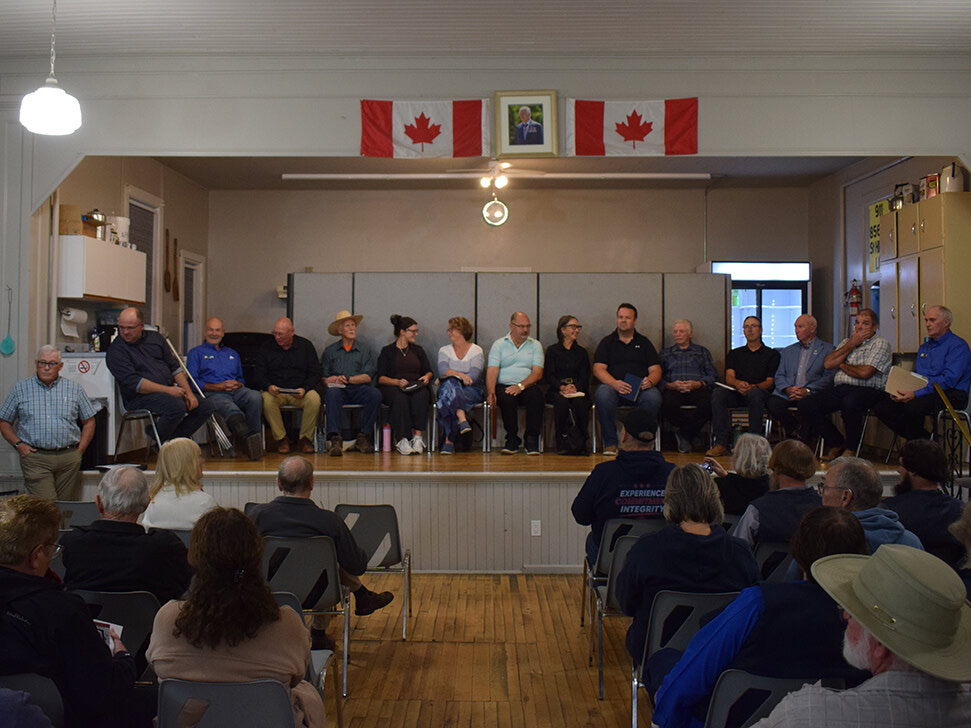
Crowded field of candidates face the issues - and the public - in ACW
BY SCOTT STEPHENSON
The next municipal election will be held Monday, Oct. 26, and on Oct. 2, a full house of Ashfield-Colborne-Wawanosh (ACW) residents met their mayoral, deputy-mayoral and council hopefuls at an all-candidates meeting at St. Helens Hall.
The decisions made around a council table have a direct impact on the community. Municipal councils are responsible for decisions involving local financing and services, including roads, water and sewers, parks and recreation. In ACW this year, voters will elect a Mayor, a Deputy Mayor and five Councillors-at-large.
With the candidates gathered at St. Helens Hall, the evening offered residents an opportunity to hear directly from those seeking to represent them. The two candidates seeking the mayor's chair offered very different reasons for putting their names forward.
Ben Van Egmond said he is running because he wants to see a change in the way municipal affairs are handled. “I’m running because I want to change the way things are happening,” he said. “I believe the government works for the people - not the other way around.”
Current ACW Councillor Evan Hickey is also seeking the mayor's position. “I’m running for mayor to build on what I’ve learned over the past four years,” he explained. “I want you to be heard. I want my council to be transparent, accountable and responsible for decisions being made for now and for the future.”
Incumbent Deputy-Mayor Bill Vanstone is seeking another term in the same position. “Good municipal government starts with listening to the people you represent,” he told the gathering. “As ACW continues to grow, we need to maintain the services our residents value, keep taxes in focus, invest wisely in our roads and infrastructure, and plan responsibly for the future.”
For Vanstone, those responsibilities also come down to how people are treated. “Most importantly, I believe in fairness and respect. Everyone deserves to be heard and treated equally.”
Challenging Vanstone for the Deputy Mayor's position is Lauren Rooyakkers, who acknowledged that she may be a new face to some ACW voters, but not to local government. Rooyakkers grew up in Belgrave and pointed to previous municipal experience as preparation for the position. “In 2022 I ran for council in East Perth, got the most votes and was nominated as Deputy-Mayor,” she said. During her time on East Perth Council, Rooyakkers served on the Roads Committee, Planning Committee and Committee of Adjustment. She was also involved with the East Perth Library Board and Conservation Board.“I learned a lot about planning, roads, culverts, bridges and budgets,” she said. “I want to continue that work, so I came back to ACW.”
With a sizable group of candidates seeking one of five council positions, moderator duties included finding a way to get everyone to the microphone. Candidates were asked to speak in reverse-alphabetical order by surname.
Ken Zelazny said his experience has taught him that municipal government has many of the same practical responsibilities as a business. “At the end of the day, a municipality is a business too,” he said. “It has revenues, expenses, assets, employees and taxpayers to be accountable to. But unlike a traditional business, its bottom line is community service.” For Zelazny, effective local government starts with listening. “I’ve always said: two ears, one mouth.”
Candidate Patti Wilkins had not yet arrived at the meeting when it was her turn to speak.
Organic farmer Tony McQuail used his time to outline what he described as a four-point approach to ACW's future. “We’re facing a lot of uncertainty, both in terms of the political climate and the natural climate,” McQuail said. “We are in tumultuous times, in terms of every moment, and I think that’s something we can work on as a community.” His priorities included greater representation for residents, regeneration of the environment, equitable redistribution of services and redesigning local systems to be less dependent on outside sources by making better use of resources within ACW, Huron County and Southwestern Ontario.
Current ACW Mayor and dairy farmer Glen McNeil is running for a council position this term. “The strength of ACW is our diversity,” he said. “We have fertile farmland, and our residential growth along the west coast helps keep our taxes down for everyone.” McNeil also emphasized the municipal experience he would bring back to the council table, having served two terms as Mayor, two terms as Warden of Huron County and two terms as Chair of the Western Ontario Wardens’ Caucus. He has also served as Chair of the local hospital in Goderich. “I offer that knowledge and experience to the council table.”
Longtime Goderich resident Gord Leaman offered a different kind of qualification - frankness. “I have absolutely no experience in government whatsoever, so I do carry an open mind and will listen to anybody who needs me to listen,” Leaman said. “I’m really concerned about the farm community in ACW, and all the small businesses. I would like to have a chance to look after all of that.”
When council hopeful Dan Hayden threw his hat into the ring, it was accompanied by a long resume and a little hope for the future. “A lot of people today just see me as a farmer raising corn, wheat, soybeans and winter wheat while promoting soil health, but I have quite a bit of experience working with construction, operations and maintenance, human resources, contractors, landowners and all levels of government. I also volunteer with a number of events, including the Dungannon Super Pull, Dungannon Agricultural Society, Huron County Grain Farmers of Ontario, the ACW Agricultural Property Standards Working Group Committee and, most recently, the Magnetic Moments fundraising campaign, bringing an MRI machine to the Goderich hospital…. My three teenage sons are the reasons why I’m running for council. It’s really important to me that the next generation has a good home, a good place to live.”
David Errington also brings a combination of agricultural and business experience, along with previous experience on council in the 1990s. “With this blended background, I feel like I can serve all taxpayers and rural society,” Errington explained. “Since I last served in the 1990s, council has started to lose touch with electors on important matters such as infrastructure needs, development, local businesses and agriculture… in order for your voices to be heard, I advocate for more appropriate times for meetings so you can attend as often as possible.”
Peggy Ducharme, a relative newcomer to ACW, advocated for the value of an outsider’s perspective. “I spent my career predominantly in Ottawa, in the municipal realm… I worked on provincial laws, local laws, international boards and a lot of economic development work on major capital infrastructure projects - like LRT transportation and bus transit. When I retired here four years ago, one of the first things that we noticed was that Highway 21 was closed in a winter snowstorm. We were locked in our community for eight days. We couldn’t travel 900 metres to the open road - to go to work or have a doctor’s appointment. I thought - this is impossible to comprehend. I just couldn’t accept that. I’m the type of person that, if there’s a problem, I will solve it.”
Benmiller's MacKenzie Deuschle described herself as a working mother, farmer and nurse who has been involved in the community for many years. “I know what it’s like to work, raise a family, run a farm here and volunteer at ACW. It’s my whole world, and I wouldn’t want it any other way,” Deuschle told the crowd. “What I’m hearing is people want change, and I do, too. That’s why I’m standing up here tonight. I think we need people around the council table who live here, who know their community and understand the everyday realities of the people they’re representing… I’m not coming in here with a big personal agenda. I love ACW just the way it is. But I do think you can make things better. There’s room for more openness, approachability and kindness in the way we all deal with each other.”
Former councillor Murray Curran kept his remarks brief. “I’m running for council again,” he stated. “I think we need to get more transparency, accountability and concentrate on our ACW infrastructure.”
Over the years, farmer Paul Bollinger has made his voice heard during the public comment section of several ACW council meetings, and this year, he’s hoping to become one of the people elected to listen to those public comments. “In 1987, I moved with my wife and four children to Canada. We have 11 grandchildren and five great-grandchildren. We’ve been married for 54 years,” he intoned. “I will stand up for no increase in all property taxes. I will reorganize the whole council organization and open all meetings on a public basis, so people can see where the money goes. I will respect private property and private property rights. Right now, farmers pay 25 per cent of the municipal residential tax rate. I hope I can help to reduce farmland taxes by 10 per cent. I hope I can bring back the evening council meetings again, so people have more time to attend the meeting and get involved in municipal affairs.”.
With such a broad field of candidates, there was no shortage of perspectives at St. Helens Hall. There were farmers and businesspeople. There were candidates with previous municipal experience and others seeking elected office for the first time. There were longtime residents and relative newcomers. There were people whose professional backgrounds included agriculture, health care, construction, planning, transportation, economic development and community volunteering.
The range of candidates was matched by the interest in the room. Residents came out to listen, and the evening provided an opportunity for the people seeking office to explain why they believe they should be among those making decisions for ACW.
Whatever the result on Oct.. 26, the all-candidates meeting demonstrated that municipal politics in Ashfield-Colborne-Wawanosh is not simply a matter of names on a ballot.