
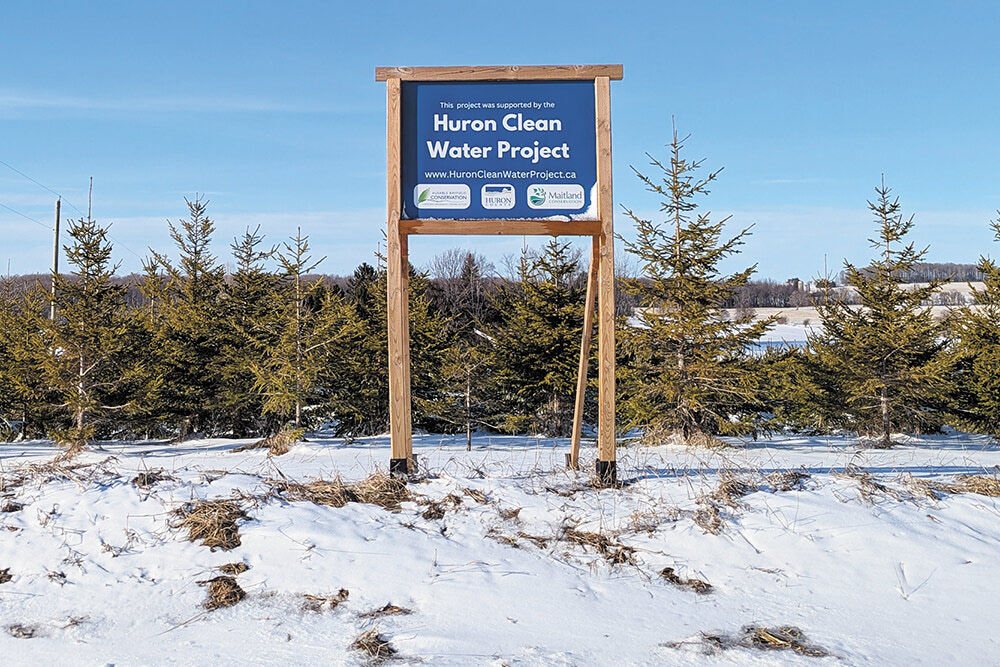
FARM 2026: Huron Clean Water Project to wind down this year at council's direction
BY SHAWN LOUGHLIN
Earlier this month, amid tough budget considerations that saw the axing of numerous public outreach programs and more than a dozen employees, Huron County Council directed staff to wind down the Huron Clean Water Project, ending years of support of water conservation projects and millions and millions of dollars of investment in the community’s environmental infrastructure and safety.
While some existing funds are committed to projects still hanging on from 2025 and some that have been approved in the first few months of 2026, no further projects will be approved and the project’s reserves, which number in the hundreds of thousands of dollars, seemingly, will be redistributed throughout the county, though a final decision on that has yet to be made. Council has opted to not allocate the typical year’s $400,000 to the project for this year (which is annually topped up to $500,000 with $100,000 from the project’s reserves) and has asked the committee to return to council later this year with a plan to wind the program down by the end of the year. Furthermore, some councillors have expressed a desire to have the project’s finances cleaned up by the end of the year, meaning that nothing associated with the project will require funds in 2027.
During the difficult rounds of budget deliberations, several councillors fingered the project as a potential avenue for cost savings, saying that if council was considering dropping public-facing programs and, eventually, eliminating over a dozen positions, that handing out hundreds of thousands of dollars in grants year after year felt like something that should be considered for elimination.
Then, as council considered the budget again on March 4, it went ahead with the elimination of 13 positions - as opposed to capital cuts which, many made the case, will only deteriorate further and, in many cases, see costs rise if they’re not attending to - and swung the axe on the Huron Clean Water Project, asking the committee to devise a plan on how to wind the program down by the end of the year and to present it to council at a future meeting for further consideration.
The Huron Clean Water Project was created in 2004, with its first projects being completed the following year. Having just marked its 20th anniversary in 2024 (and its more official anniversary last year), there has been a lot of success to celebrate for the county and its partners in the project: the Ausable Bayfield and Maitland Valley Conservation Authorities.
As part of his annual update presentation to Huron County Council this year, Stewardship and Lands Manager for Ausable Bayfield Conservation Nathan Schoelier - one half of the project’s administrative team with Maitland Valley Conservation Authority Stewardship Projects Lead Ben Van Dieten - not only did he relay the good news of the project in the past 12 months, but he also illustrated the impact it has had since its inception.
So, in 2025, the Huron Clean Water Project approved 279 projects throughout the county - the vast majority of the 285 applications that were submitted. Over $376,000 in project grants was approved by the Huron Clean Water Project Review Committee, which helped facilitate $1.2 million worth of projects, meaning that every dollar of the $500,000 provided by Huron County for the project was matched by well over $2.
Nearly half of those projects, 125 to be exact, were cover crop projects - the most popular category in the Huron Clean Water Project in recent years. Nearly $125,000 was granted to those 125 projects, which included nearly 8,300 acres of land.
This was followed by 81 tree-planting and naturalization projects for $138,256 in grant dollars, planting over 23,000 trees, and 20 invasive species management projects for $16,605 in grant funds. These projects aided the management of phragmites, Japanese knotweed, European buckthorn and more.
Since the program launched in 2004 and its first grants went ahead in 2005, 4,325 projects have been completed with a total project value of $18.5 million compared to just over $5 million in grants paid over that same period of time.
In his presentation to council last month, Schoelier boasted that every dollar invested in the Huron Clean Water Project has been matched by $2.66 in investment. Since the project was founded over 20 years ago, 438 wells have been upgraded, 643 wells have been decommissioned, 50,000 acres of cover crops have been planted, 1,208 tree-planting projects have gone ahead, 309 erosion-control projects have been green-lit and 118 manure storages have been decommissioned.
As he ended his presentation, Schoelier said that the program has long been the envy of other counties. As a result, in the last year, Schoelier said that he and his colleagues have assisted with the development or continued growth of two similar programs, one in Lambton County and the other in Perth County.
For those unfamiliar with the program, it hands out grants for a portion of the work in a number of areas that seek to protect the county’s water supply, keeping it clean for generations to come. They are, as approved by Huron County Council at that meeting last month: erosion control measures, $6,000 maximum grant; special projects, $3,000; rural stormwater management and wetland creation, $6,000; clean water diversion, $3,000; tree-planting and naturalization, $5,000; livestock access restriction, $3,000; manure storage decommissioning, $3,000; community projects, $2,000; forest management plans, $1,000; wellhead protection, $1,250; well decommissioning, $1,250; invasive species management, $3,000; crop cover incentive, $20 per acre with a 100-acre maximum; living snow fences, $20 per tree plus $500 per acre; wellhead protection area reforestation project, $20 per tree plus $500 per acre, and restoration incentive program, $300 per acre.
As a result of council’s decision, neither Schoelier nor Van Dieten were able to discuss the project for this story, as the project will now be presented for elimination, instead referring The Citizen to Huron County Council for comment on the decision made by the politicians regarding this program.
At that meeting, only three of the present 15 councillors voted against the dissolution of the Huron Clean Water Project.
After first discussing the future of the program in budget deliberations last month, council initially opted to hold back $400,000 in funding for the program after hearing that its reserves exceeded $620,000. Council directed staff to use those funds for the program for this year with the future of the project to be determined at a later date. (The annual allotment to the project has been $500,000 - $400,000 from the levy and $100,000 from its reserves.)
The project has $620,500 in unallocated reserves available. First, Councillor Bernie MacLellan suggested redirecting whatever was left over from the year’s allotment to further bring down the tax levy increase. However, Huron County Treasurer Michael Blumhagen told MacLellan that if council still wanted to put $500,000 aside for projects this year, there would only be $120,500 left over, which would not make a sizable impact on the budget.
As part of the discussion earlier in the year, when council spoke about the program, those talks were closely connected to the future of the local conservation authorities based on direction from the provincial government. Councillors were concerned that if Premier Doug Ford went ahead with his plan to amalgamate dozens of conservation authorities down to just a handful, that the county would no longer have the staff to administer the program and would not, due to financial reasons, have the means to bring it in house, so that that could be a reason to consider it for elimination.
Those concerns have panned out, with the provincial government moving ahead with its plan and local conservation authorities in wait-and-see mode.
For now, however, what the Ausable Bayfield Conservation website calls “one of the most successful on-the-ground water quality improvement projects in the Province of Ontario” will be in limbo with Huron County Council pushing ahead with its demise by the end of the year.