
FARM 2026: Maitland Valley Conservation Authority marks 75th anniversary amid uncertain future
BY SHAWN LOUGHLIN
Those who work for the Maitland Valley Conservation Authority, who serve on its board and volunteer for its foundation are ready to ride a roller coaster of emotions in 2026. What began as a milestone year of celebration will still be that, but it is sure to be clouded by the uncertainty of the provincial government and its plan for mass amalgamation of Ontario’s conservation authorities, aiming to reduce 36 organizations into nine, largely based on their closest Great Lake.
This decision was floated late last year, but brought forward officially by the provincial government earlier this month. Ontario’s conservation authorities - who, along with their member municipalities and other partners have, nearly unanimously, denounced the move, advocating instead for local control and input - will now be asked to submit a plan to align with the amalgamation early next year. However, what that will look like and what the provincial government is looking for are questions that still need answers, so those with conservation authorities, including long-time employee Jayne Thompson, say that they are largely in wait-and-see mode in regards to the next steps until they know a bit more.
In fact, General Manager Phil Beard, who had planned to retire this year after decades with his local conservation authority, has called off that well-deserved celebration, wanting to help shepherd the Maitland Valley Conservation Authority through any changes that may be waiting around the corner. His steady hand guiding the organization through these uncharted waters will surely be appreciated by the employees who call the authority home and the board and foundation that work to support its work.
And that work is good work. Speaking with the aforementioned Thompson and current Maitland Valley Conservation Authority Board Chair Ed McGugan, who just began his third year in the position, what is being done locally is being done well, efficiently and in a way that connects with local landowners and stakeholders. They agree that this anniversary year, regardless of what uncertainty awaits the organization in the new year, is most certainly worthy of celebration.
McGugan says that while the team, the board and the foundation will be doing much to mark the milestone internally, for the public, there will be a number of ways that they can join in the celebration as well. There will be some lengthy initiatives, like a photography contest, but later in the year, the organization will again host its fall colour tour at the Wawanosh Nature Centre and a River Fest at the Brussels Conservation Authority later in the summer. The foundation has also worked extensively to fund a new pavilion at the aforementioned Nature Centre, which the organization hopes will be constructed and open to the public later this year - thanks in large part to an anonymous $100,000 donation that will help bring the project to fruition.
McGugan’s path to being involved with the Maitland Valley Conservation Authority began when he was simply a resident of the area, living in Huron-Kinloss over 15 years ago. Their home property is home to a creek and between 4,000 and 4,500 trees they have planted in that time. He said he worked with the conservation authority to protect the property and help transform it into what it is today. It was also then that he developed a tremendous admiration for the authority and its staff as they guided him through properly caring for his property.
He brought this attitude along with him in 2018 when he was elected to Huron-Kinloss Council, where he inherited a position on the Maitland Valley Conservation Authority Board. He has since been elected the chair (this will now be his third year, as he was reaffirmed at the authority’s annual general meeting earlier this year in Blyth) and he also currently sits at the vice-chair of Conservation Ontario.
Because of that involvement with the local conservation authority, both personally and from an administrative side, McGugan sees the local body as one to be worked with, not to be feared. He says that while there is sometimes grumbling about conservation authorities slowing down development and construction, he sees it in a different way. He says that conservation authorities are there to help people build safely and in a way (and location) that will avoid costly and inconvenient potential flooding down the road.
Along those lines, he thinks that the Maitland Valley Conservation Authority (MVCA) has done so much work for the community over the years that it’s hard not to argue for its place in the world and the impact it has had. Sure, he says, there is the work with landowners and its consultation piece, as well as the work to keep local soil on the fields and water clean (it all ends up in the lake, repeating a slogan that the Lake Huron Coastal Centre has adopted in recent years to remind residents that the impact on local rivers and streams doesn’t stop there) but its biggest gift to the area and its residents has been its recreational opportunities. He says that the trails, the conservation areas and the campgrounds have proven so popular and see so much usage in the years following the COVID-19 pandemic that it’s hard to argue with those results. McGugan and his wife are avid outdoors-people and they utilize trails and nature areas as often as they can and he says that the trails and conservation areas are so inviting and welcoming that it’s a true testament to the work being done throughout the community.
While McGugan is relatively new to the MVCA world, Communications and GIS-IT Co-ordinator Jayne Thompson has been with the organization for decades and her connection to the Maitland River dates back to her childhood, so, in many ways, she’s dedicated her life to its health and vitality.
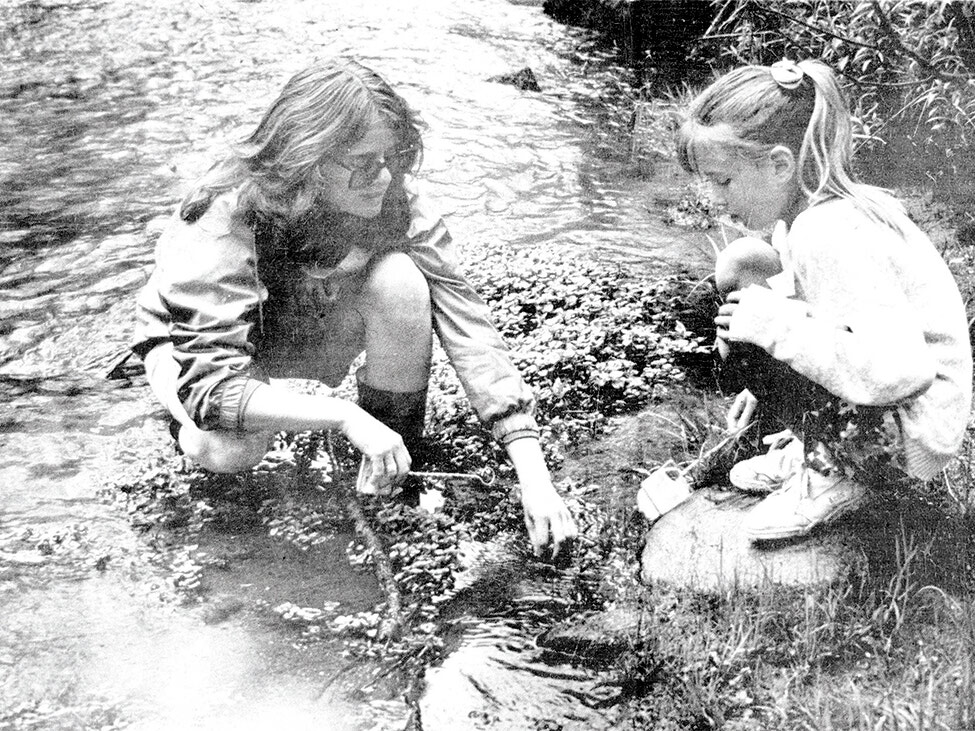
Thompson started with the education arm of the MVCA in 1990. She studied Environmental Science at the University of Waterloo, which is what led her to work with a handful of Ontario’s other conservation authorities before landing at the MVCA. Growing up, her parents owned property in the Howick area and she remembers summers of playing in the Maitland River, so when she made her way back, ready to ply her trade, it was special for her to be back where, in many ways, it all began.
She says that while her position within the organization has changed a few times over the course of her over 35 years with the MVCA, it’s much of that educational work that has stuck with her over the years and, as she has found out, with plenty of others as well.
Thompson says that one of the most rewarding aspects of her job, as she’s entered her fourth decade with the MVCA, has been reconnecting with people who were part of one of her courses or her outings, remembering it and relaying the positive impact that it (and she) had on them. Knowing that she has helped people connect with their world more has been one of the greatest achievements of her life, Thompson said.
She also pointed to study after study that shows a direct correlation between people who spend more time outside and connected to the land as children, then growing up to be people who care about the environment and preserving it for generations to come. So, over the years, the more people she’s been able to get outside, the greater number of budding environmentalists she’s helped to create and send out into the world.
Over those same years, she says that the MVCA would be nowhere without the support of its partner municipalities and other shareholders, as well as its partner organizations from upper-tier governments to grassroots environmental organizations like the aforementioned Lake Huron Coastal Centre. Even now, she says, as the conservation authorities of Ontario face existential change from the government, the support and advocacy coming from the local municipalities has been overwhelming.
As a long-time employee - at least 36 years with the MVCA and counting - Thompson says she has seen much change over the years and, if she had to pin it down to one overarching theme, it would be the implementation of technology and how it’s improved the work being done by the Maitland Valley Conservation Authority.
She says that while it may sound simple, the implementation of e-mail, cloud-based software and digital photography has eased the burden of work with the MVCA and they are now able to make short work of tasks that used to take much longer.
On that note, she said that the amalgamation of conservation authorities throughout the province has been attributed to speeding up the development process and not bogging down construction in red tape. Whether or not this is a problem in some of the larger city centres, she can’t say, but she does know that the average turnaround of applications or requests for consultation within the MVCA is less than a week, which she says it pretty good. So, for that justification, she doesn’t see the need for change, but, as she mentioned, the staff remains in wait-and-see mode as the next steps of the process start to become more clear.
She too echoes the Lake Huron Coastal Centre’s rallying cry of that it all ends up in the lake, so there needs to be an understanding that the well-being of the smallest tributary creek, river or stream is a factor in the health of Lake Huron and that the importance of the Great Lakes speaks for itself. She also says that the MVCA is one of many conservation authorities that is taking the approach of focusing on the overall health of the watershed and its impact on its community. A healthy environment means a healthy economy and a healthy economy means a healthy population. Those are points that need to be hit home as their truth has played out for years in plain sight.
For more information on Maitland Valley Conservation or to keep up with its anniversary year events, visit online at mvc.on.ca.