
FARM2026: Ginn Creek Estate Winery in the works at former Central Huron beef farm
BY SHAWN LOUGHLIN
It’s the dawn of a new day at Ginn Family Farms between Clinton and Goderich - or at least it will be soon - as the family is in the process of launching a new Huron County winery, which will eventually be known as Ginn Creek Estate Winery.
Jim Ginn, who many will recognize not just as an area farmer, but as the mayor of Central Huron and the former Huron County Warden, alongside his wife Brenda, have begun work on a new winery on their Highway 8 farm, not just as a new venture for the family, but as an attempt to enrich the wine culture of Huron County and aid its economic development in helping to make it one of the rising stars of wine production in Ontario.
The hope, Jim said in an interview with The Citizen, is that the rising tide will lift all boats and that the more wineries there are in a close proximity to one another in Huron County, the more people will aim to visit the area and construct a wine-tasting trip within Huron County. Some may take a trip to visit two or three wineries, Jim said, while others will seek out a more critical mass when looking to travel within the province. And, with most wine-related trips in Ontario taking place in areas like Niagara-on-the-Lake and Prince Edward County, the proof is certainly in the pudding in that regard.
The Ginn family is well known throughout Huron County as having agricultural roots and being a voice of the farmer. Ginn’s father Gerry was the Warden of Huron County in 1978 when the International Plowing Match (IPM) was held near Wingham on the Armstrong farm. It was Gerry’s belief that a farmer should be the warden for the year in which the county hosted the IPM.
Jim then adopted this same way of thinking when he was elected warden, knowing that a farmer should be at the head of the county in 2017 when the IPM went ahead in Walton. The success of that strategy is hard to argue when both IPMs are remembered as two of the best agricultural celebrations the county has ever seen, even with the lost time in 2017 due to the adverse weather.
Jim and Brenda had cattle at their home farm for nearly 20 years (and counting, though the herd is getting smaller and smaller each year in anticipation of the next steps) but the Ginn Creek Estate Winery project is a form of succession planning that is not often seen in Huron County. The pivot is a big one, but one that the Ginns think will be successful and one that has a place in this community that didn’t really exist 20 years ago.
Richard Fitoussi, a Bayfield-based consultant, penned a study for the county within the last 20 years about the possibility of Huron County turning into a wine-producing area due to the warming of the climate. He identified a handful of temperate corridors within it, but the potential has grown since those days and grapes are able to be grown in many areas in Huron County as long as the vineyards are managed properly.
While some jumped on board sooner rather than later, others put that information in their back pocket. Fitoussi appears to have been right and, one by one, wineries have been popping up around Huron County. There are now six established wineries in Huron County with another three, including the Ginns’, in development.
Jim knows the land well. It’s hilly and home to Ginn Creek (per the name of the winery) and Jim has a lot of faith in the land and its ability to grow what it will be asked to grow in the coming years.
He said that, going into this drastic change of the work the land will be doing, he had no concerns that it would be able to produce grapes, but that it was certainly going to be different for the land.
Since the Ginns started farming beef there, their children have always had their own ideas as to what the property should be. Their son thought it would make a great golf course (it would) and their daughter Kaylie always thought it would make for a beautifully scenic winery. She was either more persistent, more convincing or both and the Ginns decided to pivot their operation to a winery a few years ago.
They are now near the tail end of the planning process, preparing for the construction of the winery building either this fall or next spring. The morning of our interview, they received the feasibility report from the consultants on several aspects of the winery, including its electrical needs, but had yet had an opportunity to review it.
The Ginns have already gone through the planning processes necessary for the winery, severing the property and preparing it for construction. The building will include the winery itself, storage space for the barrels and a small bar and tasting room, as well as a two-bedroom, two-bathroom apartment above the winery and a house for Kaylie and her husband, who will be returning to Huron County to be part of this project.
They are closing in on hiring a local winemaker and will be producing four varieties that are known as Minnesota varieties, intended to be grown in traditionally cold regions. There will be two reds - Marquette and Baco Noir - and two whites - Frontenac Gris and L’Acadie blanc, a hybrid grape.
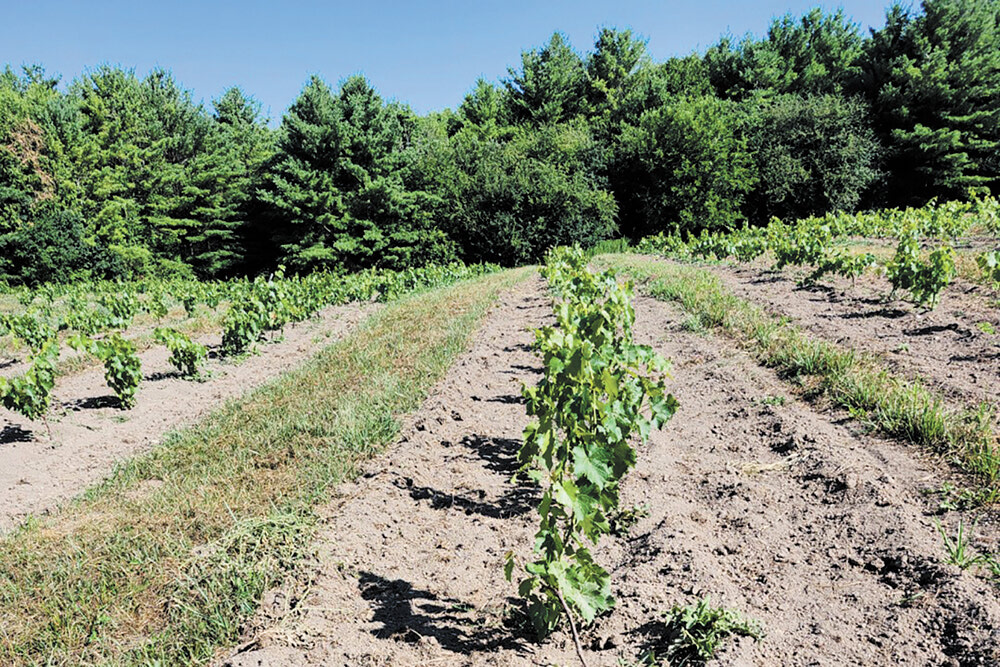
The family planted the vines last year and saw bunches of grapes growing within 30 days of planting, which is further to Ginn’s point. They weren’t able to be used and weren’t ready for wine just yet, but Jim still thought it was pretty neat to see grapes growing on the property so soon after planting and after the property has been used so differently for so many years.
The property itself has been the recipient of a lot of tender loving care over the years. The Ginns have completed over a dozen conservation projects there over the years and planted over 1,000 trees. Jim has always been passionate about conservation and environmental causes, so he’s keen to incorporate that into the building design, with solar panel capability and geo-thermal heating, and to the winery itself.
Since the process began, both Brenda and Jim have worked to educate themselves further on the world of wine. While they both had enjoyed a glass or two of wine with dinner for many years, neither of them will admit to being an expert. However, they have been learning what they need to learn and applying it to their project quickly.
While the family business will surely see all hands take on all tasks at times, the preliminary division of labour is that Brenda and Kaylie will take care of things within the winery’s walls (with the exception of the winemaking, of course), while Jim and his son-in-law will maintain things outside of the building and throughout the property.
As for the winery’s name, it begins with the aforementioned Ginn Creek, which winds throughout the family’s property. When it comes to “estate”, the couple thought it would communicate well that all of the grapes being used in the wine are grown on the property, something they’re very proud of. They’re excited, once the juice starts flowing and they’re able to bring their wine into the world, what the wine-drinkers of Huron County and beyond will think of it. They hope that will be in the fall of 2027, but because of the fluidity of the creation of the winery, the timeline will determine itself to a certain extent.
The property, which is at the centre of both the family’s and the winery’s story, spans 315 acres between Clinton and Goderich. It was once four separate lots before being merged and then severed again. It’s hilly, scenic and beautiful, in large part to the number of trees planted by the family over the years.
The Ginns also have been very grateful to have the help and support of all of the Huron County wineries they reached out to throughout this process, with their fellow wineries knowing that they were looking to be part of the same market.
Jim said that there is a clear understanding that a rising tide lifts all boats in regards to the creation of a wine industry/destination in a community like Huron County, so the established wineries throughout Huron County have been tremendously friendly and helpful along their journey.
That has certainly made life easier and helped get them excited about the next chapter of the project, which, at this point, has yet to be written.