
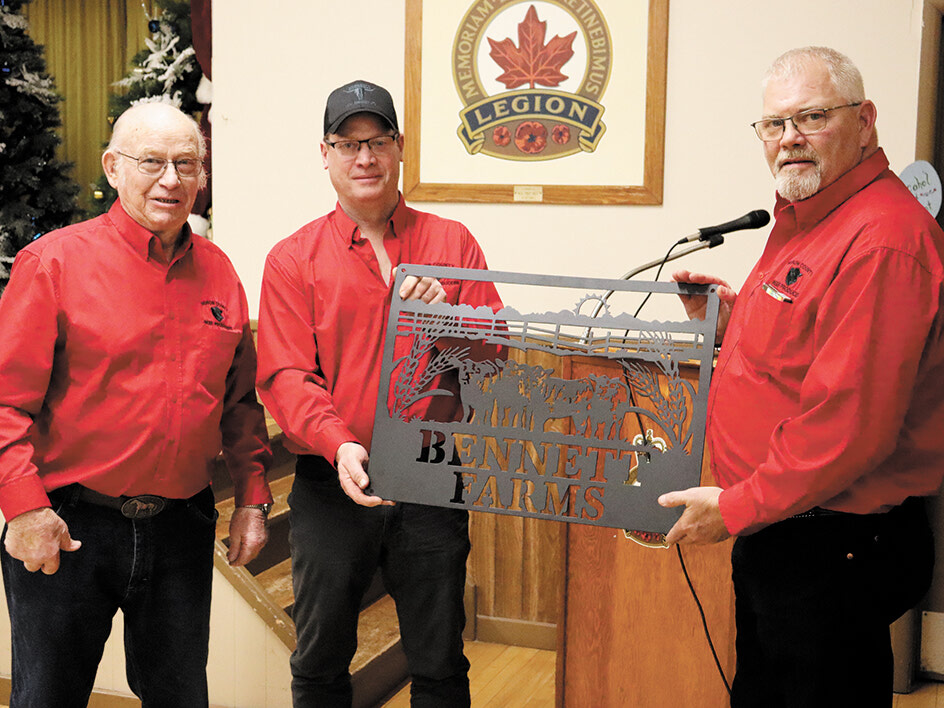
FARM2026: Harvey Hoggart marks 20 years as Huron County Beef Producers' Advisory Councillor
BY SHAWN LOUGHLIN
For Harvey Hoggart, the Clinton resident and lifelong farmer around the Londesborough area, the only way to begin his 77th birthday was by sitting down with The Citizen and reflecting on his life in agriculture - specifically as a leader within the Huron County Beef Producers.
Last month marked Hoggart’s 20th year as the organization’s Advisory Councillor at the Beef Farmers of Ontario’s annual general meeting in Toronto. The position is somewhat of a liaison between the local, grassroots beef organizations and the provincial body. For two decades, Hoggart would bring the concerns of the Huron County Beef Producers to the Beef Farmers of Ontario (and the Ontario Cattlemen’s Association before it) and, vice versa, he’d return to his home organization to preach the good word of what was being done at the provincial level.
This hasn’t always been a smooth process, Hoggart says candidly. Because he has been involved at the provincial level for so long, he is a believer of the work of the Beef Farmers of Ontario; both in the lobbying the group does and the new marketing strategies being rolled out at home and into new markets. However, he has found that some local farmers don’t necessarily see the benefit of the provincial body, so it’s been his job to sell them on the advantages he is seeing to varying levels of success over the years.
Through Ontario Corn-Fed Beef, markets continue to open up in Asian and Middle Eastern countries that had not been available to Canada in the past. It certainly has been a welcome change since the slamming shut of the borders in the wake of the BSE discovery in Canada in the early 2000s. Those were dark days, Hoggart remembers, with dismal sales even at home and a bleak future combining to create a pretty grim picture of the beef industry.
The true believers persevered, however, and little by little the markets began to reopen and the industry healed itself, growing bit by bit. Now, the beef industry is seeing some of its highest prices in recent memory spread across its four sectors. However, Hoggart says that beef is always cyclical. The industry, like any other, has its ups and downs, but having said that, even within a flourishing beef industry there can be winners and losers between the cow-calf farmers, the feedlot crowd, the finishing group and the retail market. By design, they all can’t be up at the same time, so while some will be up in the market, others will be on the other side of that coin.
Hoggart says all this to say that he has been in the industry for a very long time and has seen its ups and downs. Before BSE was foot and mouth disease and before that, surely, there was something else, he said.
Right now, he said, the market is great, so farmers are able to freshen up machinery and update some things around the farm, but there isn’t enough money flowing right now to buy more land, which always makes it tough to expand the herd. And, back to the cyclical nature of the industry, he says he remembers that the beef industry was flying high before BSE, which, of course, was not on anyone’s radar. Being sideswiped like that means there could always be concerns around the corner and a beef farmer always needs to be prepared for those concerns, regardless of how good things might be at the time.
Hoggart was born on the same Winthrop Road farm (77 years before our interview to the day - it was a Saturday night, he says, as the Barn Dance program was on the radio) that he worked for many, many years. His father had beef cattle, as well as pigs, and Hoggart remembers helping and doing chores at the farm about as early as he was able to walk.
One of six siblings, Hoggart remembers his father investing in a new trucking business just a few years after he was born. As a result of that decision, Hoggart and his brothers and sisters were left with their mother to manage the farm when their father was on the road. Having said that, it wasn’t long until Hoggart was pitching in with the trucking business too. He remembers with a laugh his father making two livestock runs in a day and returning home before the second and picking Hoggart up so he could drive home at the tender age of 15 so his father could grab some shut-eye in the passenger seat.
Hoggart and his brother John continued to work on the family farm for years, helping their father as he juggled the operation at home and the trucking business on the road.
In the late 1980s, things began to change and Hoggart took on the farm and the trucking business, at first with help from his brother who eventually went his own way, not wanting to do it anymore, so Hoggart bought him out and went it alone (with his wife Yvonne by his side, of course).
They would continue with the trucking business until it became no longer financially viable to do so. Bigger trucks were dominating the market and there weren’t enough jobs to generate the revenue to buy one of those behemoths, so they eventually decided to exclusively focus on the farm. Hoggart remembers driving one of the trucks home one day from doing a favour for a neighbour and getting pulled over by the police because the truck was not up to snuff for the road. He convinced the officer to let him drive it home on the condition that, upon arrival, he’d take the plates off of the truck and hand them over. He remembers the officer being surprised, saying he’d never seen anyone do that before, but Hoggart told him that he was doing him a pretty big favour, finally and decisively making that decision for him.
The beef market was down for a time when the Hoggarts took over and they were, for a while, spending more than they were making, so Yvonne began working off of the farm to help supplement the family’s income.
As mentioned, things began to turn around as the late 1990s turned into the early 2000s. Just as the Hoggarts were starting to see some daylight in their chosen path, the BSE crisis undid all of that hard work and, overnight, the market was devastated, not to return to its pre-BSE form for many, many years after that initial infection.
Hoggart took a few minutes to reflect on that time, saying that producers were holding onto their animals for as long as they could, hoping markets would change, but some ended up holding onto the animals for too long, ending up with cattle that were 1,800 or 2,000 pounds with no market for them, even within the country.
As Dan Hoggart, one of Harvey and Yvonne’s sons, has been cleaning out some old paperwork from the farm, he stumbled upon a sales receipt from around that time. The family had sold three animals and their total income from the sale in Brussels was $109. (For comparison’s sake, in the first month of this year, the average rail grade price for one steer was $528.50, according to the Beef Farmers of Ontario, though that is more than double the $252 that Ontario farmers were making in 2019.)
When Hoggart first took over the farm on his own was when he first became involved with the Huron County Beef Producers. He’d been part of the organization since the mid-1990s when in the mid-2000s a few members asked if he’d consider letting his name stand as the president.
Glen Walker was the president during the BSE situation, navigating those waters. Hoggart, however, wasn’t comfortable simply slipping into the president’s role without first serving as the vice-president. So, he was named second in command for a year and, after that, he was elected to the top position. Walker served a three-year term from 2004 to 2007, which is when Hoggart took over, serving at the top of the organization from 2007 to 2010.
Just before Walker took over as the president, the Huron County Beef Farmers had introduced and passed a resolution pertaining to the advisory councillor position, saying that the organization’s president would also serve as its advisory councillor after area farmer Les Falconer had served as the advisory councillor for a number of years. This was in place for Walker’s term, as well as Hoggart’s, however, after Hoggart was replaced at the top, some of the newer presidents opted not to take on the position, so Hoggart volunteered to keep the peace and stay on as the advisory councillor. Little did he know that 20 years later he would still be attending the meetings and serving in that position.
At the most recent Beef Farmers of Ontario annual general meeting, Hoggart said that there was only one advisory councillor he recognized as having been there longer than him and Hoggart said he would likely be about 90. It was then that he felt it was maybe time to move on, saying at the Huron County Beef Producers’ annual general meeting that 2026 would mark 20 years and that he felt that was enough. His hope now is that his son Dan, also the current president of the Huron County Beef Producers, will take on the responsibility, but he and the membership still have a while to decide with the next Beef Farmers of Ontario annual general meeting set for February of 2027.
Harvey says that while he might be a bit biased, he thinks Dan would do a good job and that he has the necessary skills to do it well.
Whether a Hoggart will lead the organization at the provincial level or not remains to be seen, but the family through-line in the world of Huron County beef is something that makes Harvey very proud. Two of his and Yvonne’s sons are well established now in the beef industry - the aforementioned Dan and their son Jason - and now they have grandchildren who are starting to maintain their own herds, including Dan’s daughter Kaitlyn and Jason’s sons Ty and Clay.
Looking back at the advisory councillor position, just a few years back, Harvey was at the provincial meeting in Toronto and both Dan and Kaitlyn were there as voting delegates for the Huron County Beef Producers. Having three generations there at the same time, he said, was pretty special to him and something that not everyone gets to experience in their life.
As for the future of the advisory councillor position within the Huron County Beef Producers, Harvey says he sees it as an opportunity not only to grow, but to learn more about this industry of theirs. Whether someone takes it and who that person ends up being remains to be seen, but someone will step up to be the voice of Huron County’s beef industry in Toronto next February.