
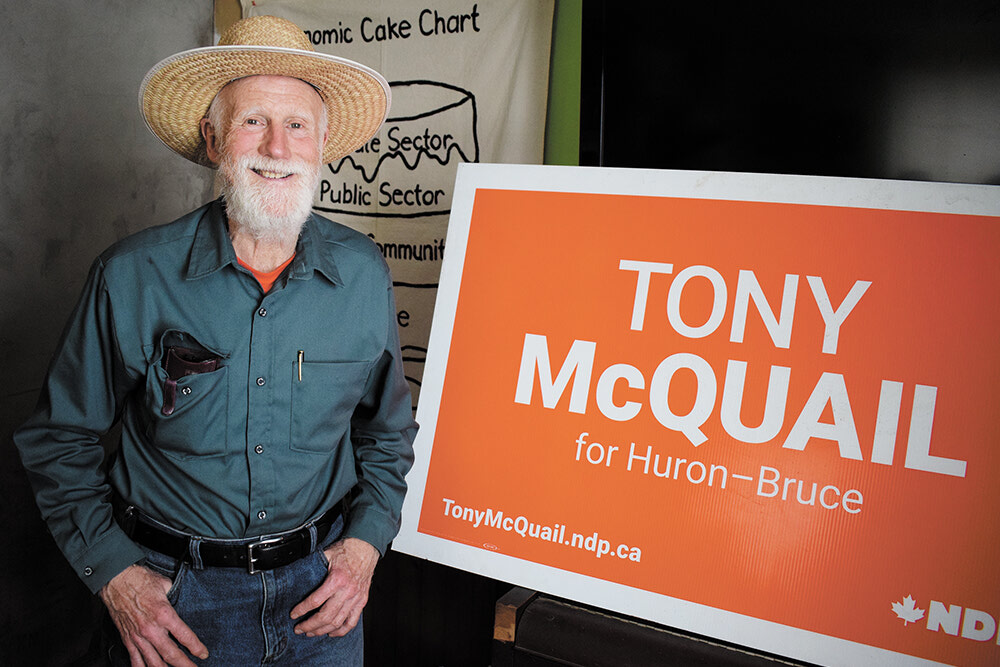
FARM2026: McQuail is back on the campaign trail, this time to be a leader
BY SCOTT STEPHENSON
Like many local farmers, Lucknow’s Tony McQuail has been spending his well-earned retirement running to be the federal leader of the New Democratic Party.
McQuail is the founder of Meeting Place Organic Farm in Lucknow, which is now run by his daughter, Katrina. And while Tony may be technically retired, there’s always something for him to do on the farm.
There are fences to mend, animals to check on, water lines to thaw in winter and the steady rhythm of chores that comes with caring for land and livestock on the family farm. On any given day, he is doing all of that while also campaigning - fielding interviews between chores, speaking with supporters and helping guide a small but determined political effort that has unexpectedly captured attention far beyond rural Ontario. There is no neat dividing line between the two roles. “There is no average day on a farm and there’s no average day in an election campaign,” Tony pointed out in one of several conversations he had with The Citizen.
This is not Tony’s first foray into politics - Meeting Place is a farm freckled with little pops of colour in unusual places - each one a reminder of Tony’s previous political campaigns. Bright orange signs emblazoned with the words “Vote Tony McQuail” have been given new life on the farm - some of the weatherproof signs have been used to repair a shed roof, others are insulating the nesting baby quail in the barn. (And yes, the McQuail family does raise quail because their name is McQuail.)
Repurposing his old campaign signs is right in step with Tony’s politics. From day one, this farmer has stood out on the campaign trail - and not just because of the hat! Tony’s deep connection to the land drives a farm-forward campaign. He has entered the federal NDP leadership race with a message that places agriculture, rural communities and ecological stewardship at the centre of Canada’s political conversation. Whether he ultimately wins or not, many observers say his presence in the race has already shifted the tone of the debate.
The philosophy behind his campaign is summed up in what he calls the “four R’s” - representation, regeneration, redistribution and redesign. His approach to politics, he says, is collaborative rather than combative. “I’m not interested in fighting for people,” he declared. “I’m interested in working with people. When you work with people, you end up working for the things that actually need to get done.”
Several times over the course of his campaign, Tony has paused his fundraising efforts in support of the race’s other grassroots candidate: Tanille Johnston. The growing camaraderie and mutual respect between these two ostensible rivals has been one of the campaign highlights for those following along on social media.
When asked on the campaign trail about what his ambitions would be as NDP leader, Tony did not hesitate - he made it clear that he has his eye on the ultimate goal: leading the country.
It is a bold stance from someone who readily acknowledges that the odds are long. “It will depend on what the membership chooses to vote for,” he told The Citizen. “I knew my chances weren’t great coming in. They probably aren’t great now - but people have been listening.”
What makes Tony’s campaign unusual is how firmly it remains grounded in the realities of farm life. Even during the busiest stretch of the campaign, chores still come first. “The farm is part of my grounding in reality,” he mused. That grounding, he believes, gives farmers a perspective that is often missing from political decision-making. “You see things very differently when you’re walking around at ground level. When you’re out on the land regularly, you see things from a very different vantage point than somebody who’s in a corner office 30 floors up and thinks they control the world.”
The lessons of agriculture, he says, translate directly into how leaders should approach the future. “Farmers know you have to adapt. They know you don’t control the weather, and you have to plan for the long term,” he pointed out. “We’re only here for 20, 30, 40, maybe 50 years on the farm. None of us live forever. So you’ve got to have a long-term vision that doesn’t destroy the future for short-term gain.”
At the heart of Tony’s message is the idea that agriculture is far more than an industry - it is the foundation of society itself. “Food is the basic underpinning of society. In North America, we’ve gotten used to taking it for granted.” That understanding, he says, shapes the way farmers view their responsibilities to the land. “Farmers tend to have a much better understanding of where they fit in relation to Mother Nature than most politicians… if we don’t look after the planet - whether you call it creation, Mother Earth, or the environment - it’s going to be pretty bleak.”
Much of his campaign has focused on regenerative agriculture, an approach to farming that emphasizes soil health, biodiversity and ecological resilience. “The key things about regenerative agriculture are building soil health, increasing soil organic matter, keeping the ground covered as much as possible, and keeping living roots in the soil as long as possible,” he told The Citizen.
He argues that regenerative approaches can also strengthen farm finances “Regenerative agriculture often improves the economic picture for farmers because it replaces purchased inputs with biological approaches like cover crops.”
One practice he often highlights is the use of diverse cover crops to support soil life. “I like multi-species cover crops - what some people call cocktail crops. The more diverse your cover crop, the more it feeds a wider range of soil bacteria and fungi,” he explained. “We once planted a mix with about 12 different species. In two months it was three feet high, thick as the hair on a dog’s back, and the cattle just loved it.”
Beyond improving soil productivity, he says those practices can also have broader benefits for entire communities. He explained that building up soil and organic matter across a watershed increases the whole watershed’s ability to absorb water in flood situations. “That means municipalities downstream don’t need as much defensive infrastructure against flooding,” he pointed out. “That’s a collateral benefit of good agricultural practices.”
He believes that the soil beneath a farmer’s boots is the starting point for understanding the entire food system. “Our job as farmers is capturing sunshine into crops and then either feeding those crops to livestock or selling them,” he noted. “Success in farming really comes down to how well we capture that sunlight.”
Beyond the farm gate, Tony’s campaign is also calling for stronger local food systems and rural infrastructure. “Government needs to support local infrastructure for agriculture - things like abattoirs and food processing - as we look at the uncertainties of our time, we should be thinking about relocalizing our economies and being less dependent on long-distance trade. We need healthy local and regional food systems that connect farmers directly with their consumers,” he insisted. “Food production, processing and distribution should be strong at the local level.”
He also believes that the next generation of farmers faces political barriers that many urban policymakers fail to recognize. “The biggest political barrier facing the next generation of farmers is politicians who don’t understand that society rests on the foundation of food. We need a food system that’s fair all along the way - for farm labourers, temporary foreign workers, farmers, processors and consumers - when food systems become highly centralized, wealth tends to be extracted from rural communities,” he warned.
In debates and on the campaign trail, Tony has shown little patience for economic theories that he believes accelerate that trend. “They talk about trickle-down economics, but I call it the ‘suck-out and suck-up’ theory - resources get sucked out of rural communities and sucked up to the top.”
Tony often returns to the same simple idea - that politics should work more like farming. “Farmers understand resilience because we deal with uncertainty every day - you have to take each day as it comes, but you also have to think years ahead,” he said. “Farmers are stewards of the land and the resources under their care, and that perspective is something politics could learn from.”
Whether that message ultimately carries him to victory remains to be seen. For now, the campaign continues - sometimes quite literally between chores on the farm, where the cattle still need checking and the fences still need fixing, regardless of what the polls say.
But regardless of the final result, McQuail believes the effort has already accomplished something meaningful.“When I reached out to people and asked what they thought, they said what I was talking about gave them hope,” he told The Citizen. “We need a little more hope, and we need action behind that hope - and as a farmer, I know how to turn vision into action.”