
FARM2026: Snobelen Farms feeds the world from Huron, Bruce Counties
BY SCOTT STEPHENSON
When stepping inside the large facility at Snobelen Farms’ Lucknow headquarters, the first thing one notices is a loud, distinctive rattling. It’s the sound of the world being fed - the sound of soybeans being sorted. It’s the sound of a steady stream of pale yellow beans, making their way through a highly-customized soybean-processing system designed to ready only the highest-quality soybeans for international and domestic shipping.
Snobelen Farms Export Manager Colin Richardson was kind enough to not only give The Citizen a guided tour of the facility, but he also had a lot of information to offer about what happens to these noble legumes when they leave Lucknow and journey to the furthest corners of the earth.
First, field detritus and foreign agents alike are shaken loose from dried soybeans and discarded. Then, the soybeans rattle their way through a system that sorts them by size. Once all like beans are with like, they are rigorously inspected for any defects. At multiple stages along the way, each batch of soybeans is tested for quality. Soybeans slated for export are also tested repeatedly to ensure no GMO material has inadvertently made its way into the final product.
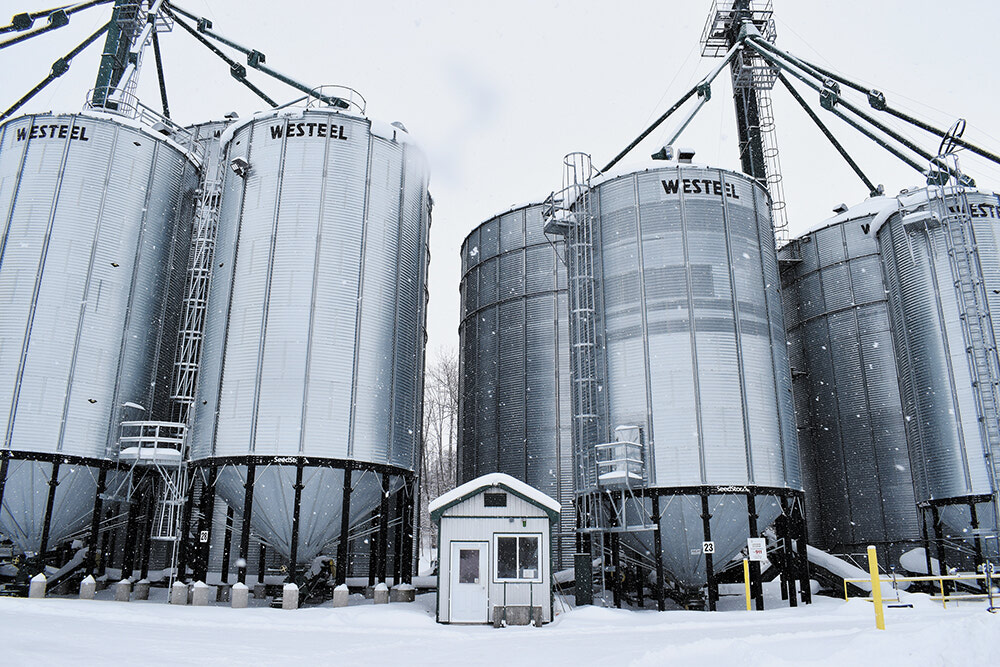
Snobelen Farms Ltd. has grain storage silos scattered across Southwestern Ontario, but the business is headquartered in Lucknow. What began as a local grain storage operation has gradually evolved into an agricultural operation that connects local farms across Huron and Bruce Counties to dinner tables around the world. “We have eight locations across southwestern Ontario,” Richardson explained to The Citizen. “Our first and flagship location is Ripley, where the family farm and grain elevator started in 1971 - this all began as a single grain elevator receiving grain from local farmers, and the business has grown from there.”
In those early days, the goal was straightforward: provide a place where farmers could deliver their grain after harvest. Corn, wheat and soybeans would be received, stored and shipped to domestic buyers. The idea that soybeans grown in the fields of Southwestern Ontario would one day be exported around the world wasn’t on anybody’s radar.
Soybeans aside, Snobelen’s still does brisk business as a standard grain elevator. And, at its core, the work of a grain elevator has not changed that much since 1971. “Grain elevators in this area receive, store, condition and ship commodities like corn, soybeans and wheat,” he said. “Our role is really to handle the storage and conditioning for farmers and then ship the grain when end users need it.”
Grain elevators like Snobelen’s help farmers navigate volatile commodity markets. “Farmers rely on grain elevators to help market their grain and make sure they’re getting the best possible price,” Richardson noted.
Over time, however, global demand has created new opportunities - particularly for food-grade soybeans. Walking through the Lucknow facility, Richardson had many opportunities to bring attention to the various points in the process when soybeans are inspected to ensure that every bean meets the company’s strict standards of quality. “All grain has to be dried to a safe moisture level so it doesn’t spoil during storage or transport,” he explained. “For food-grade soybeans we use natural air drying instead of heat, because heat can denature the protein and affect the quality.”
This level of quality control is essential when soybeans are destined for human consumption. “After harvest, we receive the beans, condition them, process and package them, and then load them into shipping containers for export,” Richardson told The Citizen. The packaging is done by a slick team of human supervisors and specialized robots that handle most of the heavy lifting.
Proper labelling for export is also essential - each package of beans must be labelled in accordance with the labelling laws of the country it is destined to travel to. The soybeans waiting to be shipped at Snobelen’s are marked with many different languages.
Once packaged, labelled and loaded onto trucks, the soybeans begin their sojourn to another place. “Most of our food-grade soybeans are shipped in containers,” Richardson said. “They’re loaded here, trucked to rail yards in Toronto, then shipped by rail to ports like Vancouver or Montreal before heading overseas. From there, the ocean transit to Asia usually takes one to three weeks.
“Japan is our number-one export market,” he explained. “Soybeans are a major part of the diet there, but they can’t grow enough domestically to meet demand.” Snobelen Farms also ships soybeans across Southeast Asia and into other international markets. “Across the Indo-Pacific region there’s a huge opportunity for Canadian soybeans,” he informed The Citizen. “Because the population is growing and more people are entering the middle class - those regions eat a lot of plant-based foods, so soybeans are a natural fit.”
The beans moving through the Lucknow facility are part of a food tradition that stretches back thousands of years. It is believed that the soybean was first domesticated in China between roughly 6,000 and 9,000 years ago. It became a cornerstone of agriculture throughout East Asia, valued for its nutrition, versatility and ability to grow in difficult conditions.
In societies where meat was scarce, soybeans provided an important source of protein. Over centuries, cooks developed countless ways to transform the bean into everyday foods.
Many of those foods remain staples today. Soybeans are used to produce tofu, soy milk and soy sauce, along with fermented foods such as miso and tempeh. Today, mapo tofu - a mix of tofu and pork served in a spicy sauce, is one of the best-known Chinese dishes, served at restaurants worldwide.
Snobelen’s export program focuses specifically on dried soybeans destined for processing, but fresh young soybeans and soybean sprouts are also eaten around the world. “Our soybeans are used in products like soy milk, tofu and other specialty soy foods,” Richardson says. One of the most specialized products made from our local soybeans is natto - a traditional Japanese snack made of fermented soybeans. Natto is famous for its pungent odour and prized for its slimy texture.
Snobelen’s export program depends on carefully-selected soybean varieties grown by local farmers. “We export 10 to 12 different soybean varieties, some of them very niche products for specialty foods,” he explained.
One well-known variety is OAC Strive, which was developed through the University of Guelph. In recent years, Snobelen has been working with the university to develop its own soybean varieties, to great success. “We’ve also started developing our own exclusive genetics.”
For Richardson, this work brings together several of his passions: farming, science and global trade. His own path into the industry began with academic research. “My background is in agriculture. I studied at the University of Guelph and completed my Master’s degree there, working in plant breeding,” he recollected. “My education and background were focused on soybeans, so that’s always been a crop I’ve been very fond of.”
Selling food-grade soybeans overseas also depends on building long-term trust with international customers. “Building international markets is still very relationship-driven,” Richardson explained. “Countries like Japan place a lot of value on trust, so it’s important to spend time there, visit customers and host them here in Canada… being a family-owned company helps build that trust when customers see the people behind the business.”
Those international relationships, forged by trust, are the paths by which the humble soybean travels from the farms of Huron-Bruce to feed families seated together at tables all around the world.