Filmmaker and journalist aids in curating Wingham Truth and Reconciliation display, programming
BY SCOTT STEPHENSON
Canada has been observing the National Day for Truth and Reconciliation (NDTR) since 2021. This year, an effort to deepen the collective understanding of the meaning of this day in Wingham has already received an overwhelming response from the community.
North Huron staff are preparing for a large turnout at the township’s flag-lowering ceremony on Sept. 30, while a children’s book presentation by Indigenous author Kristi White has attracted so much interest from local schools that it has been moved from the Wingham library to the 400-seat Town Hall Theatre.
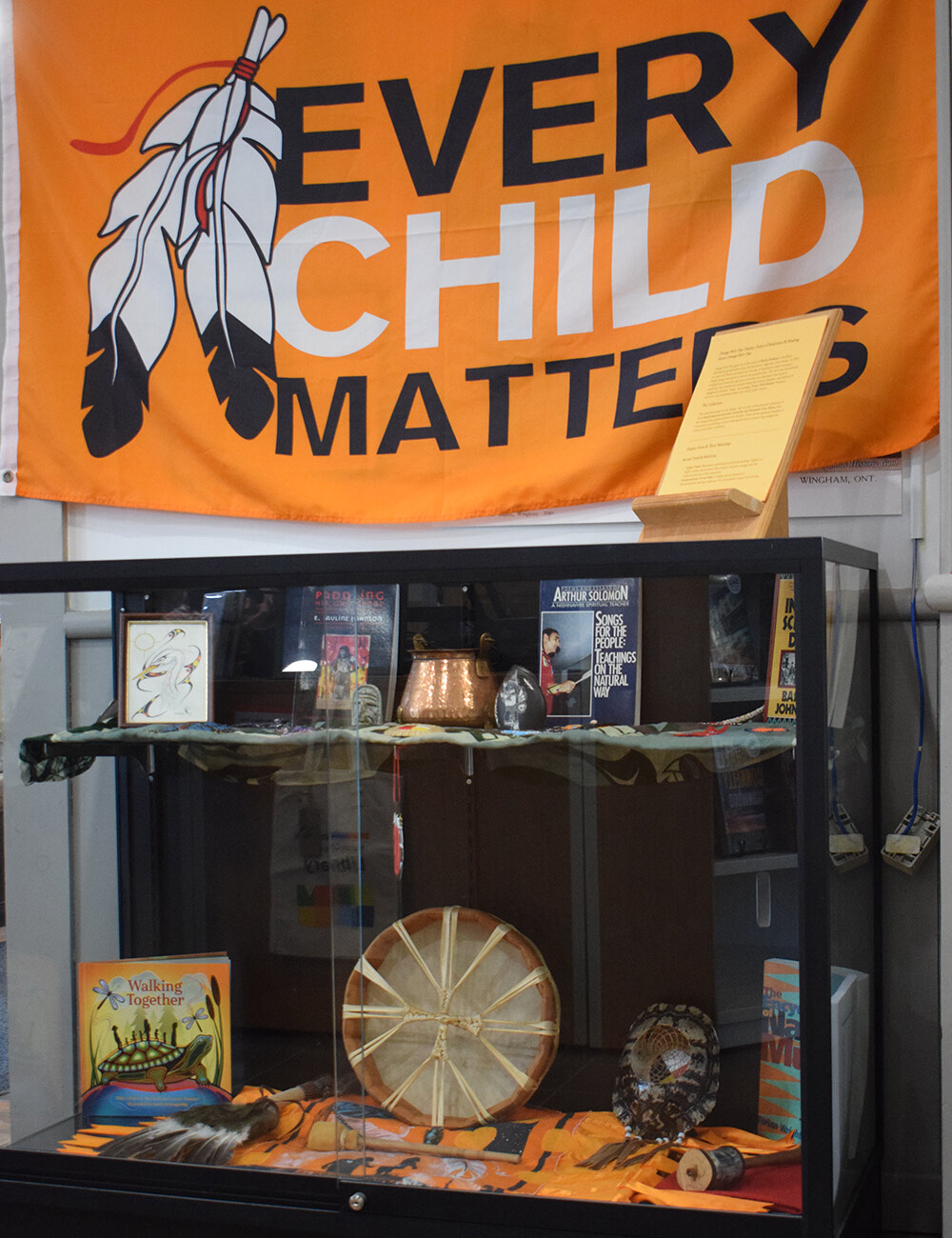
In addition, for the entire month of September, an Orange Shirt Day installation has also been on display at the Wingham library, curated by Haudenosaunee storyteller, journalist, filmmaker and NDTR event programmer Cory Bilyea. The Citizen sat down with Bilyea to talk about the community’s response to the expanded programming, and to learn a little bit about what truth and reconciliation means to her.
When conceptualizing a suitable event to introduce a young audience to Indigenous culture, she knew that White, a children’s author and member of the Oneida Nation of the Thames, was the right choice. White has written five books in her Adventures of Jay and Gizmo series - each angled at offering children an accessible way into conversations about Indigenous language, culture and representation. “She’s somebody who can really talk to kids,” Bilyea told The Citizen. “She knows how to give them the information that they need so they can look at a native kid in their school with long hair and see just another culture,” Bilyea explained. “As for native kids, they can see somebody that looks like them in a book.”
While she knew White was the right choice, Bilyea was less sure about the level of public interest. “I was a little worried that people wouldn’t come, or we’d have five kids, or something like that,” she confessed.
Instead, the response has been strong enough to force a change of date and venue. As word of the reading spread, more local schools began expressing an interest in attending. Bilyea and the other organizers quickly realized they’d need a bigger venue. North Huron was just as quick to offer up Wingham’s Town Hall Theatre as an alternative, and the free event’s capacity suddenly went from 70 seats to 400. It is also now occurring in October - a fitting reminder that acknowledging Indigenous history isn’t September-specific.
Literacy, Bilyea believes, is an important part of the reconciliation process. “There’s lots of points to why literacy is important - it’s not just to get gainful employment - if you can’t read, you can’t communicate,” she explained. “When I was a little girl, my greatest escape from all the trauma that was going on around me was to read. It was an escape for me. It gave me an outside look at the world as opposed to this little nightmare I was trapped in as a kid.”
The youth programming is part of a broader effort to make Truth and Reconciliation into something the people in North Huron actively participate in, rather than simply observe one day a year. At 10 a.m. on Sept. 30, North Huron will hold a community flag-lowering ceremony. Bilyea will also be at the Wingham library in the afternoon with reference books and other material for people who want to ask questions or learn more.
While the amount of interest in these activities is heartening, for Bilyea, a successful step towards reconciliation shouldn’t necessarily be measured by the size of the crowd. “Success to me is if one person shows up to the flag lowering,” she pointed out. “That’s planting the seed. It’s up to the individual person after that whether they want to water that seed.”
The NDTR may be relatively new, but it grew from decades of advocacy by residential school survivors and Indigenous communities. This day of national recognition is not something Canada just decided to declare out of the goodness of its governmental heart - it was legally compelled to do so as part of the settlement of the largest class-action lawsuit in the nation’s history.
The Indian Residential Schools Settlement Agreement (IRSSA) was a landmark decision that included compensation for former students through the Common Experience Payment, the Independent Assessment Process for serious physical and sexual abuse claims, the Truth and Reconciliation Commission, funding for healing programs through the Aboriginal Healing Foundation and funding for Commemoration Projects.
The NDTR grew directly from Call to Action 80 of the Truth and Reconciliation Commission’s 94 Calls to Action, which was established through the IRSSA. It called for a statutory holiday to honour survivors, their families and communities, and to ensure that the history and legacy of residential schools remained a matter of public commemoration. The federal government introduced a bill in 2020 to establish Sept. 30 as the NDTR.
Sept. 30 was already a significant day for Indigenous communities before the federal holiday was created: Orange Shirt Day. In 2013, Orange Shirt Day began as a grassroots initiative honouring survivors and the children who never returned home from residential schools. It was inspired by Phyllis Webstad’s account of having her new orange shirt taken from her when she arrived at a school when she was only six years old.
Webstad’s stolen shirt came to symbolize the loss of culture, freedom and self-esteem Indigenous children experienced in the residential school system. In curating the library’s Orange Shirt Day display, Bilyea sought to restore that which was lost. “I chose symbolic gestures. For instance, I threw in the Mohawk language book - for the importance of revitalizing our language,” she noted. “The copper vessel has a lot of stories to it... it’s part of the purity of Mother Earth. My hand drum, because the drum is the beating heart of Mother Earth.”
During her tenure reporting for the Wingham Advance Times, Bilyea never shied away from opportunities to put the truth on the public record. But her own understanding of that history, and her place in it, has taken years to uncover. As a Sixties Scoop survivor, Bilyea also grew up separated from much of her own culture. “I don’t know my own language. I don’t know my grandmother. I don’t know any of my aunties or uncles, or any of the longhouse traditions,” she explained. “I’ve since been gifted by the Anishinaabe - to go to their ceremonies and to learn Anishinaabe.”
As a child in Cambridge, when her adopted mother disciplined her with threats to send her to a residential school, Bilyea didn’t understand what the words meant. “People weren’t even taught about it back in the 1970s and 1980s. I didn’t know about residential schools until I was well into my twenties or thirties,” she recalled.
Rather than focusing exclusively on residential school trauma, Bilyea selected objects for the library’s Orange Shirt Day, in order to open doors into Indigenous cultures and traditions. “I want people to know that, yeah, there’s trauma, but we’re not all about trauma,” she told The Citizen. “The goal is to give people the tools and the data to understand what happened. There can’t be any reconciliation until people recognize the truth of what was done to the Indigenous people of this land. In order to reconcile, people have to know what the truth is. It’s an opportunity for the people of the town to come out and learn more truth, to be supportive.”
She believes the response in Wingham shows that people are willing to listen. “People in this area who have been reading me are hungry - they’re like sponges. They want to know the truth. It all comes back to that. They want to know the truth about what happened and they want to be able to participate and they want to be able to stand in solidarity with us,” she said. “What was done to us was nothing short of genocide. People need to hear all of the voices, not just the chosen few that cater to your narrative. It starts here - in your heart. People have the ability to learn the truth.”