
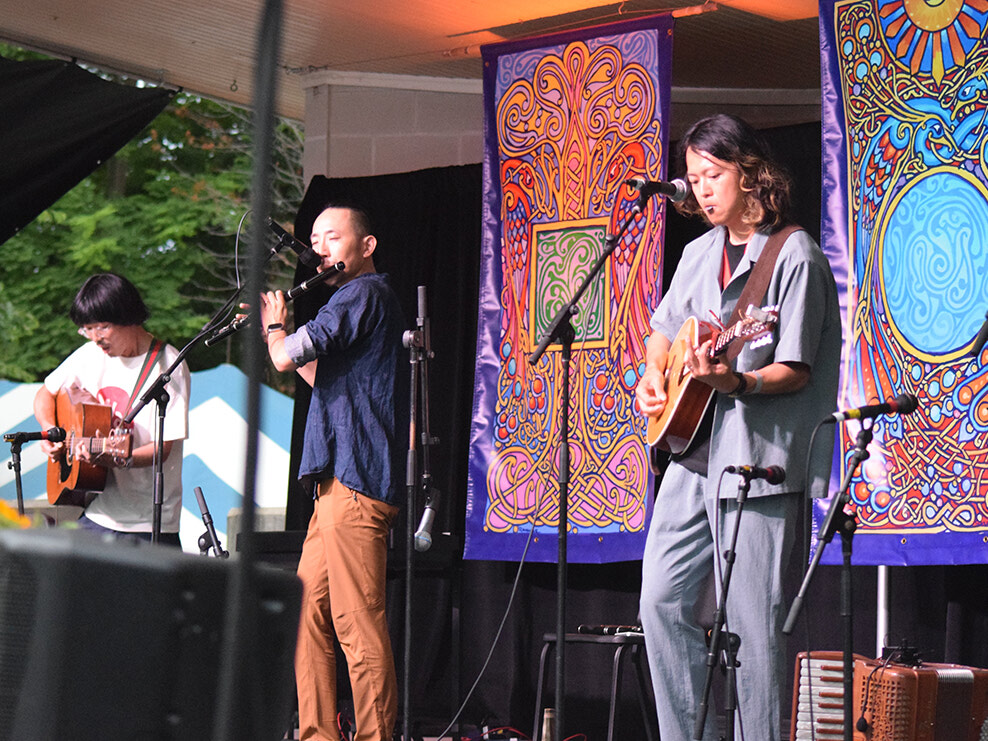
Goderich Celtic Roots Festival impresses audiences for another year
BY SCOTT STEPHENSON
Last weekend, the 2026 Goderich Celtic Roots Festival (GCRF) once again brought musicians, students, volunteers and music lovers to Lions Harbour Park to further the traditions that have made this cultural event into a fixture of the summer calendar for people all over the world.
The ancient peoples that included the Celts were not a single, unified people, but a diverse collection of groups living across parts of western and central Europe during the Iron Age. They moved, traded and interacted across a broad territory, and Celtic languages and cultural traditions developed across that landscape.
Centuries later, the movement is different, but the principle remains familiar. Musicians travel to Goderich from near and far, bringing their own traditions and influences with them. For a few days at the height of summer, fiddling, piping, drumming, singing and storytelling converge, allowing international ideas to mingle with musical traditions to create new songs that tell ever more diverse stories that take root and grow into connections reaching beyond music.
Artistic Director Cheryl Prashker opened the ceremony by highlighting the weeklong musical immersion for visiting artists that makes the GCRF so unique among festivals. “They’ve been here all week; they’ve been swimming in the lake and they’ve been eating at all the restaurants. It’s just been an amazing week,” she pointed out. This year, artists came from all over - including Ontario, Ireland, Brazil and Japan - to spend the week in Goderich. That sense of belonging is particularly evident in the festival’s extensive billeting program.
“One of the musicians said to me, ‘When we are billeted in people’s homes, we become embedded in the community,’” festival founder Warren Robinson told the crowd. “And there can be no higher praise than wanting to be embedded in this wonderful, wonderful community.” Co-founder Eleanor Robinson noted that more than 300 volunteers help make the event possible, along with the many local residents who open their homes to visiting musicians.
The gathering also provided an opportunity to remember those whose contributions have helped the festival grow. Warren spoke of longtime organizer Glen Carey, whom he described as the “conscience of the festival,” and its primary environmentalist. Trees were offered for sale in Carey’s memory at the merchandise tent as a continuation of the festival tree-planting project he had started years earlier - a living reminder that some legacies are carried forward when they put down roots. A shimmering, silvery statue of High King of Ireland Brian Boru, commissioned by Carey, also stood guard near the festival entrance throughout the weekend.
The GFCR’s ecological awareness has never been limited to trees alone - it’s quietly woven into the larger idea of stewardship of the land that was so important to the ancient peoples that inspired this festival. It’s a celebration that focuses on caring for places, and ensuring that what has been planted will be nurtured so it can continue to grow.
That concept was also evident in the festival’s newest memorial musical initiative: the Greg Reynolds Instrument Lending Library, or GRILL. Launched in partnership with the Huron County Library, the GRILL is named for the late president of the Goderich Celtic Folk Society, who passed away last year.
This program allows Huron County library patrons to borrow instruments free of charge and begin exploring traditional music without having to purchase an instrument first. The collection already includes guitars, violins, banjos, concertinas, mandolins, ukuleles, bodhráns and harpsicles, with additional instruments being added all the time.
It is a simple idea with considerable potential - inspire them at events like the GCRF, put the tools of music within reach, and see what grows.
In nature, pollinators carry something from one flower to another. It is a small act of movement that allows plants to reproduce and helps sustain the diversity of the ecosystem. The process depends on a series of encounters - on something travelling, arriving somewhere new and leaving something behind.
A musician arrives in Goderich carrying a song shaped by somewhere else. A student picks up a fiddle for the first time. A volunteer opens a spare bedroom to a visiting performer. An audience member hears an unfamiliar tune and carries it home. The result is an accumulating tradition - one increasingly enriched with the bountiful pollen of musical influence and connections.
Irish Vice-Consul General Cahal Sweeney, attending the festival for the second time, also spoke at the opening ceremony. “Diplomats like me, we come and go,” he advised. “I’m going to be gone in two years, and there is going to be someone else here in my place. It’s the people like you that actually keep Ireland alive in Canada, and keep it alive abroad.”
Warren Robinson offered a similar philosophy for the festival, and for the town he loves that sustains it. “We honour the past. We celebrate the present. And we plan for the future,” he told the crowd.
Roots matter because they anchor us to a place. But healthy things do not remain entirely in one place. Seeds travel. Pollen travels. People travel. Songs travel. And when we find fertile ground, they can take hold, flourish and become part of something larger than ourselves.