
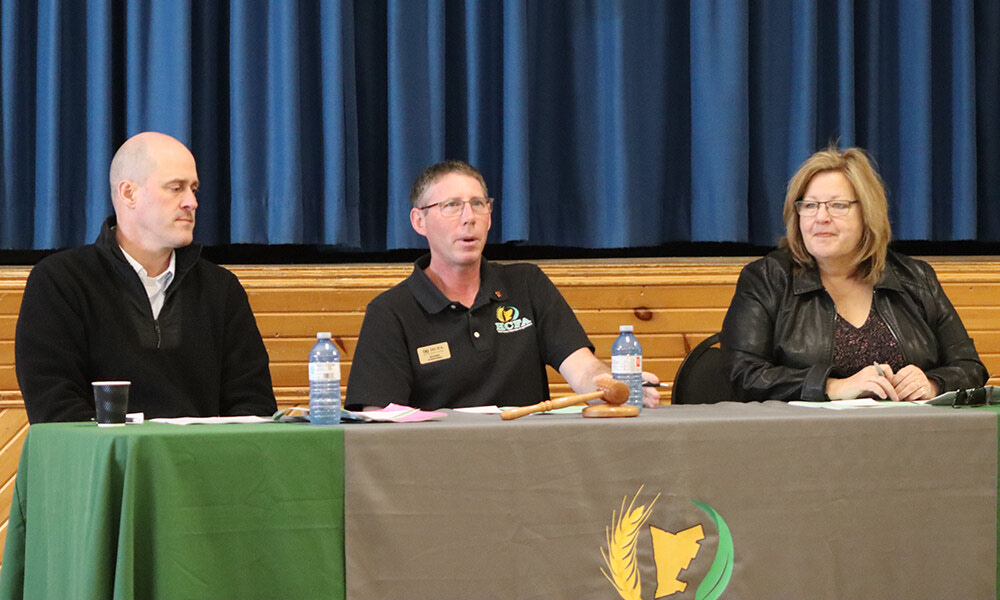
HCFA hosts Lobb, Thompson as free trade renewal dominates farming conversation
BY SHAWN LOUGHLIN
On Friday, politicians, commodity group leaders, local planners and more congregated at the Clinton Legion for the Huron County Federation of Agriculture’s annual MP/MPP Forum with Huron Bruce MP Ben Lobb and MPP Lisa Thompson as the guests of honour. One topic dominated conversation across all sectors: free trade.
Commodity group leaders of all stripes reiterated to both Lobb and Thompson the importance of free trade between Canada and the United States, emphasizing that farmers on both sides of the border are advocating for a return to tariff-free, true free trade between the two nations. This is topical, more than a few farmers said, as the review of the existing Canada-United States-Mexico Agreement (CUSMA) will take place in the coming months.
To open the meeting, which was chaired by federation President Shawn O’Rourke, both Lobb and Thompson addressed those in attendance.
Thompson lauded the work of Huron County’s farmers, saying that they are the envy of the province, but adding that there are geopolitical issues that are unignorable. She said that the provincial government has not raised taxes in eight years and that a one per cent tax cut for small businesses will be coming that should help that sector as well.
She also noted recent increases to the Ontario Municipal Partnership Fund (OMPF) allotments locally that should also help local municipalities better provide for their residents.
Lobb said that Thompson was a hard act to follow, but that he reiterated that Canada needs to be focusing on its sovereignty, but not in the Donald Trump/51st state way, in the way in which Canada ensures its own future by producing and processing its own food, securing its ports and more.
For a G7 country, he said, Canada needs to be doing more to stand on its own two feet and that fact has been laid bare by the Trump threats.
He agreed with those in attendance, saying that free trade is essential to the success of both Canada and the United States and that it needs to be a priority as the CUSMA deal comes up for renewal this summer.
Harvey Hoggart, a long-time member of the Huron County Beef Producers, was the first to speak, saying it’s a time of record high prices for the beef industry, but that’s making it difficult for new, young beef producers to break into the industry and buy land, which is also very high right now.
He also mentioned high input costs, which are contributing to the difficulty of being a beef farmer right now and noted that the renewal of CUSMA, as it stands now, would be beneficial for the country’s beef industry.
Jeff Klomps of the Grain and Oilseeds Farmers advocated for improvements to the current Risk Management Plan, saying that they are working to lobby for 60 per cent coverage on the plan. He also noted that fertilizer being cut off due to global conflicts has also been challenging for his sector and that regulations on ethanol are making it difficult for the province’s farmers to compete on a level playing field.
Martin Van Raay then spoke for the Huron County Pork Producers, saying that there seems to be a lot of provincial money available for battery plants in Ontario and, while he knows that energy is essential, he’s hoping that farms can be seen as just as essential and worthy of investment at both the national and provincial levels.
Presentations then continued as the local sheep farmers said they were pushing to increase their production in the coming years, aiming to fulfill 50 per cent of the domestic market demand by 2040, with the high beef prices driving some smaller producers to sheep. Meanwhile, the Huron County Dairy Farmers advocated for continued free trade and protection of its coveted supply management system, while also noting the donations of milk, cream and butter to local firefighters’ breakfasts, parades and other community events.
Rob Vanden Hengel, past-president of the Huron County Federation of Agriculture then detailed having the federation added as a commenting body for planning applications in Huron County. He said it has been eye-opening and good for the federation to have the platform upon which to stand in order to work to preserve farmland and ensure that the community’s ability to farm is protected at all costs. That has been ongoing for about the last 18 months and he said he felt it had been beneficial for not only the federation, but for the Huron County Planning and Development Department as well.
O’Rourke then presented Thompson, Lobb and the rest of the group with a snapshot of the impact of agriculture in Huron County. He noted that the area is home to 2,564 farms over more than 681,000 acres of farmland, making the average Huron County farm 266 acres.
In terms of local farm sales, he said that nine per cent of Huron County farms sell products directly to consumers, four operate a community-supported agriculture model, 27 farms sell at farmers’ markets and 138 farms sell directly from their farm, at a local stand or through a pick-your-own model.
The local agri-food sector employs nearly 6,400 people through over 3,000 local agri-food business establishments and Huron County farms boast $1.8 billion in farm cash receipts per year.