
HCPM26: Soil and Crop Improvement Association returns to Plowing Match
BY SCOTT STEPHENSON
Visitors to the Huron County Plowing Match (HCPM) may come out to celebrate agricultural traditions, but they stay to catch a glimpse into the future of farming.
Every year, members of the Huron County Soil and Crop Improvement Association (HCSCIA) use the occasion of the traditional plowing match to showcase a few of the latest advancements in agricultural technology. For the 2026 HCPM, the HCSCIA have decided on a sprayer demonstration to highlight how farmers can improve their efficiency while still protecting their soil.
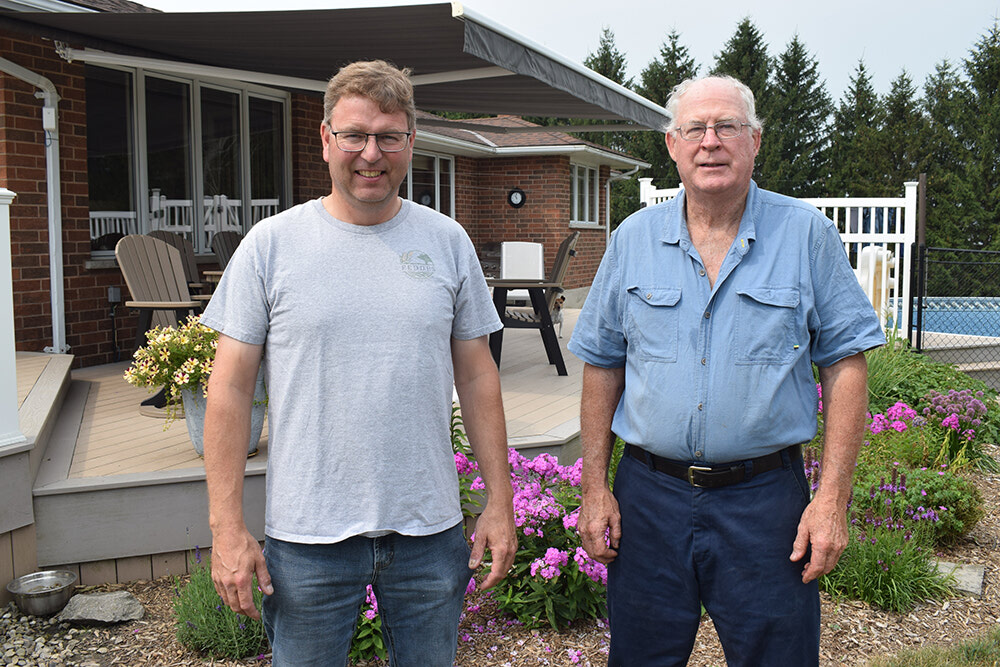
Wim Feddes and Alan Willits of the HCSCIA are focused on helping farmers make informed decisions on soil and crop improvements, as well as equipment improvements. “I think we’re a good fit for the plowing match,” Willits pointed out. “We provide people with something else to look at besides the plowing - it’s a nice alternative. We try to show up-and-coming things that are happening in agriculture.”
They noted that modern agriculture has largely moved away from traditional plowing. “There’s not much plowing being done anymore,” Feddes pointed out. “There might be the odd guy that still does it, but it’s not even five per cent, I would say. The plowing match has become more of a sport - it’s something from the past.”
Willits pointed out that farmers who continue to plow traditionally have their reasons. “If a guy is plowing, it’s because he’s decided that this is how he knows how to farm, so he’s going to keep doing it. And there’s merit in that.” he said. “Farms need to have a system,” Feddes added. “Generally, if somebody was plowing in the past, it fits into their system, and everything follows that.”
Willits explained Huron County farmers benefit from some of the best agricultural land in the province. “In general, Huron County has excellent soil,” he said. Feddes agreed, noting the variety found throughout the county. “There’s some spots that have clay or sand, but on average, we’ve got nice, loamy soil,” he said.
That soil quality is something farmers can appreciate, especially during difficult growing seasons. “If you have timely rains, you can grow good crops on compacted soil, because the rain keeps recharging your moisture for you,” Willits said. “But if you get into a year where you don’t have timely rain, that’s when you suffer.”
Soil health is all about increasing resilience. “We’re in about a good, long drought right now,” Willits said. “When you have proper soil health and proper soil management, your crop looks healthier, because we have the ability to bring moisture up from deeper in the soil profile to feed our crops.” Poor soil management can create challenges during dry conditions. “If you’ve been abusing your soil, there’s a good chance you have a hard pan in there, and your crop is only surviving on whatever rain there is to recharge that top eight or 10 inches,” he said.
When it comes to growing successful crops in Huron County, soil erosion can be a major obstacle. “Because of the wind and the lay of the land where we are, most of Huron County is prone to soil erosion,” Feddes pointed out. “The less tillage you do, the better it is.” Good drainage is also a key part of successful crop production in the region. “In this part of Ontario, you have to have good drainage,” he told The Citizen. “It gives you the ability to have reduced tillage, and it gives you the ability to really expand what crops you want to grow.”
This year’s demonstration will specifically focus on how technology can help farmers apply pesticides more efficiently. “We’re going to be showing what computer technology and cameras can enable a sprayer to do,” Willits explained. “It can spot-spray. Or, when you’re driving around a curve, it has the ability to spray more on the outside boom, and way, way less on the inside boom, so you still have even coverage, which is very important.”
The HCSCIA will also be bringing drones back for demonstrations this year. “The drones in the last two years have got bigger, and the bigger drones are very similar to helicopters when spraying, which is excellent,” Willits divulged. Also new is camera technology designed to improve crop management accuracy. “It has the ability to only spray where the weed is,” he said. “If there are no weeds, it does not spray.”
The HCSCIA also strives to demonstrate that there are financially accessible options for local farmers looking to integrate emergent technologies into their existing operations. “Unfortunately, new technology always comes with a big upfront cost,” Willits acknowledged. “One of our mandates for doing this is to find alternatives to buying new. There are add-on features that you can use to retrofit the sprayer that you already have, and they can make it do some of the things that brand new sprayers have the ability to do.”
Feddes feels this approach can be particularly valuable for those nearing retirement age who still want to improve their agricultural efficiency. “60-year-old farmers are coming out and thinking, ‘I’m not going to buy a new sprayer - why would I do that?’” he noted. “But if he could add something on to his existing sprayer that would help him for five or 10 years, he might say, ‘Oh yeah, I will do that.’”
The HCSCIA demonstrations will begin at 2 p.m. on Aug. 21, giving visitors a chance to see how modern technology is shaping the future of farming while gaining a better understanding of the soil beneath their feet.