
Heart & Stroke Month: OneCare blood pressure clinic offers benefits beyond the medical chart
BY SCOTT STEPHENSON
February is Heart and Stroke Month in Canada, and earlier this week, The Citizen stopped by a blood pressure clinic at Egmondville United Church to learn more about why regular blood pressure checks matter. What emerged was not only a lesson in cardiovascular health, but also a window into the social fabric that sustains rural health care initiatives.
OneCare Home and Community Support Services operates blood pressure clinics at convenient locations such as churches and community centres across Huron-Perth, as part of the Cardiovascular Health Assessment Program (CHAP).
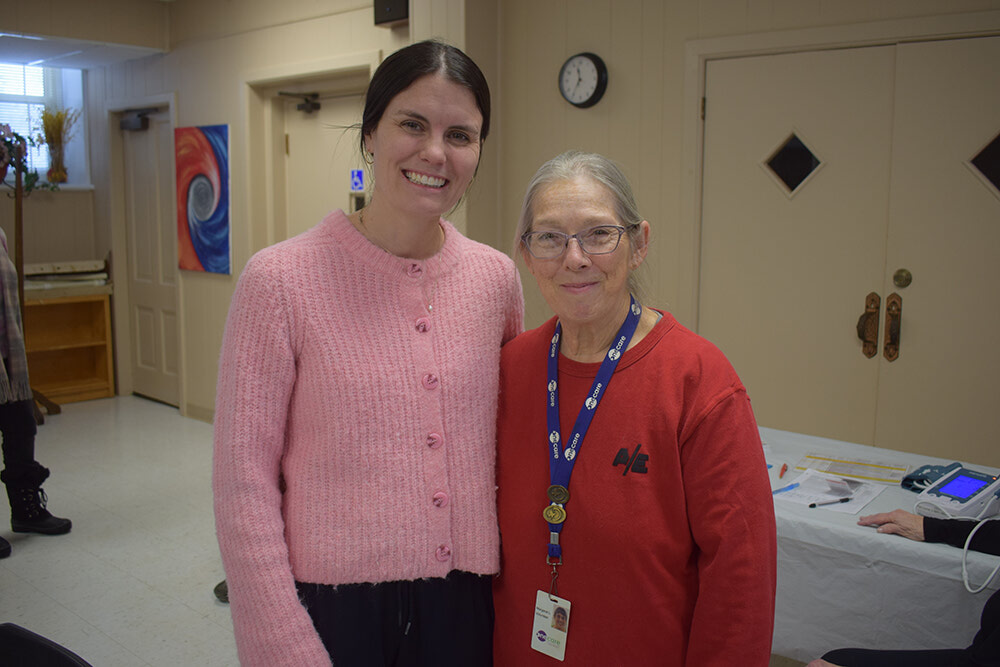
It may have been a cold and snowy Monday morning, but Community Support Supervisor (CSS) Megan Howe and volunteer Margaret Marian Lee were still revved up and ready to welcome clients to the monthly hybrid clinic-and-café set up in the basement of one of the area’s most historic churches. Although a few visitors had already arrived, the pair was able to find a little time to chat CHAP with The Citizen. “Today, we’re set up here at Egmondville United Church just before our congregate dining program,” Howe explained. “We also run clinics in Stratford and Exeter before the dining program, and in Wingham. One of the Wingham clinics runs monthly as a standalone satellite program, and another runs monthly before the dining program.”
OneCare often pairs its health clinics with community programs such as Dining with Seniors, which means that for many attendees, this is not a one-off medical appointment, but a regular opportunity to check in - not only on their health, but also with friends and neighbours they might not otherwise see during the long winter months.
The clinics serve a wide range of clients, including people managing chronic conditions such as hypertension and hypotension. Others are simply seeking reassurance in a comfortable, familiar setting. “There are people with ‘white coat syndrome,’ meaning they experience anxiety when their blood pressure is taken in a doctor’s office,” Howe explained.
High blood pressure often has no obvious symptoms, a fact that surprises many clients. “Sometimes people have high blood pressure and don’t even realize it. It can be silent,” Lee said. Howe noted that symptoms vary widely from person to person. “Symptoms of high blood pressure can vary by individual. You can’t just look at a person and know.”
As a CSS, Howe oversees the day-to-day operations of OneCare’s health and wellness programs, including its blood pressure clinics. In her experience, the key to successful community engagement is offering a service that is deliberately simple, accessible and grounded in evidence-based practice. “We’ve kind of created something that’s almost like a wellness café,” she said. “We offer blood pressure testing before dining in the hopes that people will stay for that full social piece.”
After clients register on arrival, volunteers like Lee record the average of three consecutive blood pressure readings. “We like taking the three-reading approach - research shows that it’s more accurate than just one,” Howe explained. “It’s based on research studies from McMaster’s cardiovascular health awareness program.” She added that having baseline readings can be a valuable diagnostic tool for doctors. “We encourage clients to take their readings to their medical appointments so doctors and nurse practitioners can see trends over time.”
Lee is a former OneCare supervisor for home care services who volunteered with the Dining for Seniors program during her career. After retiring, she returned to OneCare and began assisting with the blood pressure clinics. “I was going to go back to Dining for Seniors, but it was all booked up!” she said with a laugh.
As a volunteer, Lee focuses on having meaningful, one-on-one interaction with clients. She guides them through the process, and keeps detailed records. “When clients come in, they register, and we take three consecutive blood pressure readings using the machine. We go by the average,” she said. “We write it down on a client sheet, and then record it in a little book they take home so they can keep track.”
That continuity of care allows volunteers to notice both attendance and absence. “If someone stops coming, you notice. You wonder what happened,” Lee said. “Sometimes they’ve moved into a retirement home and are having their blood pressure taken there. I make a note of that.”
If a reading falls outside a safe range, Lee follows established protocols. “If the blood pressure is too high, I contact the supervisor, and then the supervisor contacts the doctor,” she said. For readings that are only slightly elevated, context matters. “If it’s just a little higher - especially if someone’s been coming for a few months and it’s suddenly way off - we ask what they were doing that day.”
Everyday factors often explain fluctuations. “If they were exercising, walking or had a scare, that can raise blood pressure,” Lee said. Medication changes can also play a role. “Others will tell you they’ve started a new medication, which could explain why the blood pressure is higher or lower.”
Over time, Lee has come to recognize that the clinics are as much about conversation as they are about numbers. “The one-on-one time is important. It’s a little social thing,” she said. “You can ask how they’ve been since the last time you saw them - any changes medically, physically or emotionally.”
Those conversations can reveal more than physical health concerns. “Sometimes people share that someone in their family has passed away, or that they’re struggling,” Lee said. When appropriate, volunteers can suggest additional support services. “We can suggest resources, like counselling through churches or community services.”
Blood pressure clinics like OneCare’s are designed to be supportive rather than diagnostic. If a volunteer like Lee notes a concerning reading, clear protocols are in place. “If there’s a concerning reading, the volunteer contacts me as the supervisor,” Howe explained. “We look at the reading, the symptoms, and how the client is feeling, and then we take next steps.”
Those steps can include consulting OneCare’s internal guidelines for high and low blood pressure, reaching out to the organization’s in-home supervisor team, or contacting an on-call nurse for immediate direction. “On top of that, we contact their doctor to make sure they’re aware of what’s going on,” Howe said. Of course, strict confidentiality is always observed.
Many participants arrive with an existing diagnosis from a health professional and use the clinic as a way to monitor their condition. “We have clients with hypertension or hypotension, and others who are monitoring conditions like diabetes, or who have higher or lower baseline blood pressure and want to track it month to month,” she pointed out.
While blood pressure is closely associated with heart disease and stroke, Howe is careful not to overstep professional boundaries. “Blood pressure is closely linked to heart disease and stroke risk, but that’s best explained in full by a health professional,” she said. “Diet and exercise are two factors I feel comfortable sharing as things that can influence blood pressure, based on what health professionals have advised.”
Both Lee and Howe emphasize that the clinics are open to everyone. “Anybody can get their blood pressure checked. There’s no discrimination,” Lee said. Howe echoed that sentiment. “Anybody can have their blood pressure checked. Even if it’s just for reassurance, reducing anxiety is a big part of what we do.”
Howe believes the community response shows that the clinic-and-meal model is working. “We’ve done a great job of creating these clinics wherever we think there’s a need within our communities. Overall, I think we’re fulfilling a definite need,” she said. “It gives clients peace of mind and reduces anxiety, and we’ll continue to explore and grow our programs as necessary.”
In rural communities, access to care can be hindered by geography and isolation - especially during the winter months. Something as small as the quiet consistency of a monthly blood pressure check, offered alongside a warm meal and a friendly conversation, can grow from a routine medical service into a crucial reminder that staying healthy is always easier when we work toward it together.