

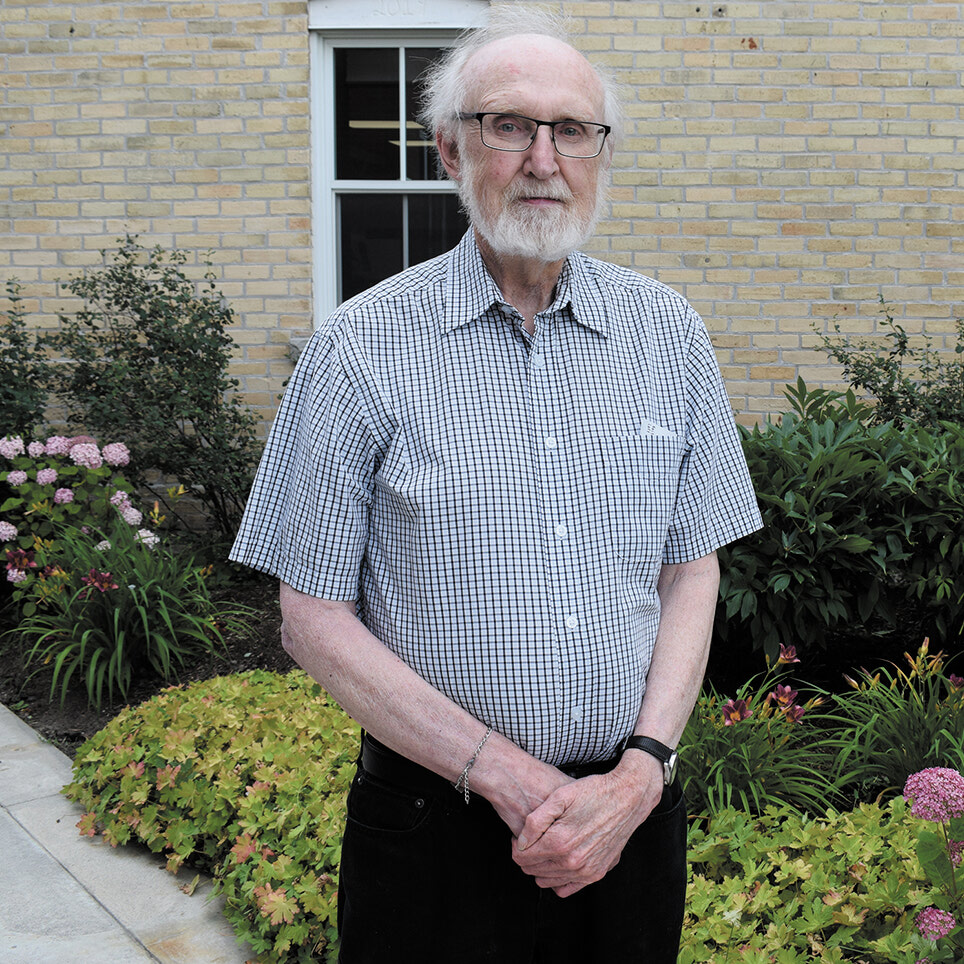
Keith William Roulston
Keith William Roulston of Blyth passed away at Huron Residential Hospice on Nov. 1, 2026. He was 79 years old.
Keith was the beloved husband of Jill Roulston (Twiner), originally of Scarborough. They were married on Dec. 21, 1968 after meeting earlier that year when Jill was a nursing student and Keith was studying journalism at Ryerson Polytechnical Institute, as it was called then, now Toronto Metropolitan University.
The couple had four children: Christina Kipfer, Jennifer (Ian) Croft, Craig Roulston and Erin Pocock and eight grandchildren: Emily, Phoebe and Ainsley Croft; Noah, Hannah and Jonah Kipfer, and Bethany and Abby Pocock.
Keith was raised on a farm near Lucknow where his parents, Clifford and Mary (Maimie) Roulston, tried to establish a farming operation after Cliff returned from active service during World War II in the Royal Canadian Artillery in Italy and Holland. After several years farming, financial difficulties caused Cliff to finally take a factory job. The couple also raised their daughter Irene Haldenby and a second son, Kenneth, on the farm.
Keith and Ken later moved to Lucknow with their parents when Irene and her husband Bill took over the farm.
From Lucknow, Keith moved to Toronto for university and, after he and Jill married, they lived in Lucknow, Clinton and Blyth, before finally settling at the farm house on Moncrieff Road, where they spent the last 51 years raising their family and tending a small hobby farm.
There will be a showing of Keith’s interview with Lisa LaFlamme for the Huron Historical Society at the Blyth Memorial Hall on Nov. 15 at 2 p.m. Please consider this an opportunity to remember him. A private family service will be held.
Messages of condolences can be sent to the family at Riverside Funeral Home. In lieu of flowers, please consider donations to the Blyth Festival or the Huron Hospice.
JOURNALISM
In the mid-1960s, Keith studied journalism at what was then Ryerson University in Toronto. Not only was that where he would meet his wife, Jill, but it was there that he would galvanize his career path as a life-long newspaper man.
At Ryerson, he worked on the school’s daily newspaper, first as the assistant sports editor, then the sports editor and finally as the editor of the editorial page, a prestigious role within any newspaper.
When Keith returned to the Lucknow area with Jill, after graduating in 1969, the pair endeavoured to create a regional sports newspaper. That project eventually didn’t pan out, so Keith built on the foundation he’d laid during summer work for The Huron Expositor, taking a job as the editor of The Clinton News Record.
In November of 1971, the Roulstons purchased The Blyth Standard from the Whitmore family, jumping at the chance to become their own bosses. During that time, the Roulstons also founded The Rural Voice magazine, which just marked its 50th anniversary last year, and The Village Squire, which published issues for just under a decade in the 1970s and early 1980s (The Townsman would eventually follow in 1991 and 1992).
When the Ontario Federation of Agriculture became a membership-based organization, many county federations began to write their own member newsletters. As a way to distribute that newsletter, the Roulstons acted on a win-win proposition by founding The Rural Voice, which would publish the newsletter every month. The Perth County Federation of Agriculture soon followed, eventually joined by the Bruce and Grey County federations, as well as several local commodity groups. The first issue was published in June of 1975.
After operating The Blyth Standard successfully for a number of years, seeing success and growth within the community, the Roulstons sold the newspaper and Keith became the first year-round general manager of the burgeoning Blyth Festival.
Blyth news was relegated to one page within The Clinton News Record after the Standard was eventually shuttered by its new owners. It was the same story in Brussels, as The Brussels Post was closed and folded into The Huron Expositor as one page of news.
It was also during this time (1978) that the Roulstons sold The Rural Voice.
Sheila Richards, a pillar of the Brussels community, approached the Roulstons in the mid-1980s about a newspaper in Brussels. Unsure of one community’s ability to support a newspaper in the economy of the day, the trio of Richards, Keith and Jill brainstormed a community shareholder model to raise the capital for what would become The Citizen - a community newspaper owned by members of that same community.
After a minor hiccup involving the Ontario Securities Commission (fundraisers sold too many shares and had to return some to avoid legal action in order to remain a private company), the first issue of The Citizen was published on Wednesday, Oct. 23, 1985. “The Citizen is truly a community newspaper,” reads one of the front-page headlines.
Firmly back in the newspaper world with the early success of The Citizen, the Roulstons bought back The Rural Voice in 1991, using a similar shareholder model to the one they used with The Citizen. With those funds, the Roulstons started North Huron Publishing, which is now the parent company of The Rural Voice, The Citizen and Stops Along The Way.
For his work with both The Citizen and The Rural Voice, Keith and the publications themselves have been honoured dozens of times both provincially and nationally. He would serve as the editor of The Citizen for a time and then for The Rural Voice for decades before handing over the reins, though he would still contribute columns until his death.
Keith served as an Ontario Community Newspapers Association (OCNA) director from 2003 to 2009. In 2013, Keith was honoured with an OCNA Silver Quill Award for 25 years in the community newspaper business. Then, in 2023, Keith was inducted into the OCNA’s Hall of Fame.
THEATRE
Not long after returning to Huron County and purchasing The Blyth Standard, a new interest sparked in Keith. This one began with a concert being held by the Blyth Lions Club, which led to Keith being central to a group looking to revitalize Blyth’s historic Memorial Hall - a campaign led by the Standard, under Keith’s leadership, was the driving force behind the renovation.
After opening decades earlier as a living cenotaph to those lost to war, the building had fallen into disrepair and could no longer house audiences safely.
Work on the building, including a new roof, took years, but, in 1972, another piece of the puzzle fell into place when Keith connected with a group of young actors, led by the great Paul Thompson, who were in the process of creating what would become The Farm Show, produced for the first time in Ray Bird’s barn. Keith and Jill were in the audience for that first show.
While there, Keith attempted to generate interest in a theatre in Blyth, at its newly-renovated hall, with Thompson. The timing wasn’t right, and Thompson moved on to other work, but when James Roy, a Clinton native, worked on a show with Thompson at Toronto’s Theatre Passe Muraille, he had similar visions for a theatre in his home of Huron County and Thompson sent Roy to discuss it further with Keith.
The two and Anne Chislett would found the Blyth Festival, which had its first season in 1975. Far from a silent partner, Keith contributed productions to the Festival many times over the years, beginning in 1977 up until a remount of Powers and Gloria, one of his most polished works, just last year.
He served as the Festival’s first year-round general manager and as a member of its board of directors for many years, including as its president for four. That time included the crucial years in the early 1990s, when the Festival was facing financial collapse and Janet Amos returned as artistic director for the rescue mission. Janet requested that Keith be board president during her return tenure.
He was the Festival supervisor for the addition on the north side of Memorial Hall in 1979 and 1980, which included the backstage area, dressing rooms and a green room for the company, as well as a fire escape, which allowed for public use of the balcony for the first time in years, and the inclusion of the administrative offices and art gallery on the ground level.
The Festival is now a major economic and artistic driver in Blyth and greater Huron County, bringing tens of thousands of people to the community every year, with some of its plays being awarded over the years.
COMMUNITY
Over the years, in addition to his work, Keith has also been very involved in his community. He has served on the former Blyth Board of Trade and as a board member of Community Futures Huron, co-founded the Blyth Idea Group and the Blyth Repository of History (a community group formed to become the caretakers of the extensive Vodden archival collection) and completed a term as the president of the Huron Historical Society.