
North Huron marks National Day for Truth and Reconciliation
BY SCOTT STEPHENSON
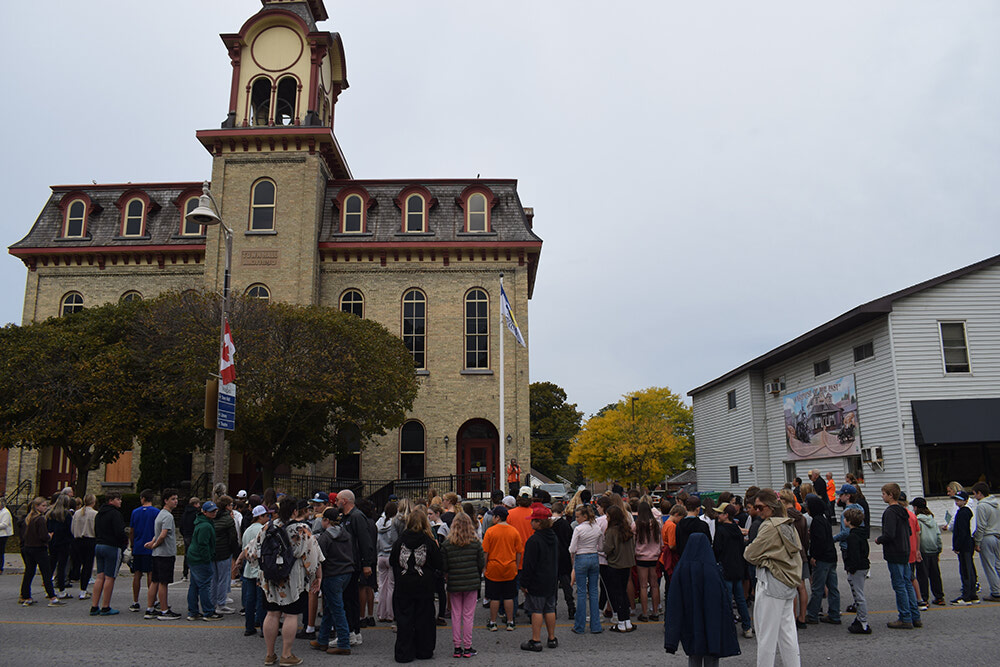
On Sept. 30, North Huron continued its observance of the fifth annual National Day for Truth and Reconciliation (DTR) with a flag-lowering ceremony at Wingham’s Town Hall.
A large crowd, young and old, gathered as the Canadian flag was lowered and Haudenosaunee filmmaker and activist Cory Bilyea, wearing an orange shirt and ribbon skirt, addressed those assembled. “Between the years of 1831 and 1996, the Canadian government and church organizations forcibly took more than 150,000 First Nations, Inuit and Métis children from their families and their homes,” she announced.
While much of this year’s DTR programming sought to build the general public’s foundational knowledge of Indigenous culture, Bilyea’s words at the flag-lowering were delivered with an intentional bluntness that cut through the abstract symbolism of moving around a rectangle of fabric. “This isn’t ancient history. The last residential school didn’t close until 1996,” Bilyea pointed out. “We wear orange today because of a woman named Phyllis Webstad. In 1973, when she was just a six-year-old, her grandmother managed to save up the money for her to buy a shiny new orange shirt to wear on her very first day at St. Joseph Mission Residential School.”
When Webstad arrived at the school, her possessions were taken from her, including the new shirt she never saw again. Orange Shirt Day was created in 2013 by residential school Survivors and their families as a way of acknowledging the loss of culture, identity and belonging experienced by Indigenous children and communities.
The ceremony was also framed as a beginning rather than an ending. “Today, your presence here in the square completely rewrites that narrative,” she said. “You matter, your peers matter, every single child matters.” She encouraged those present to continue learning, seek out books and films, challenge casual racism and carry the lessons of the day into their everyday lives.
The fifth annual observance comes as communities across Canada continue the work of learning about the legacy of residential schools and the experiences of Survivors, their families and Indigenous communities. For those gathered in Wingham, the lowering of the flag offered a moment of reflection, while Bilyea’s words provided a reminder that reconciliation cannot be confined to a single day on the calendar. “You are the generation that will rewrite the narrative of this country,” Bilyea concluded. “Keep holding onto each other.”