
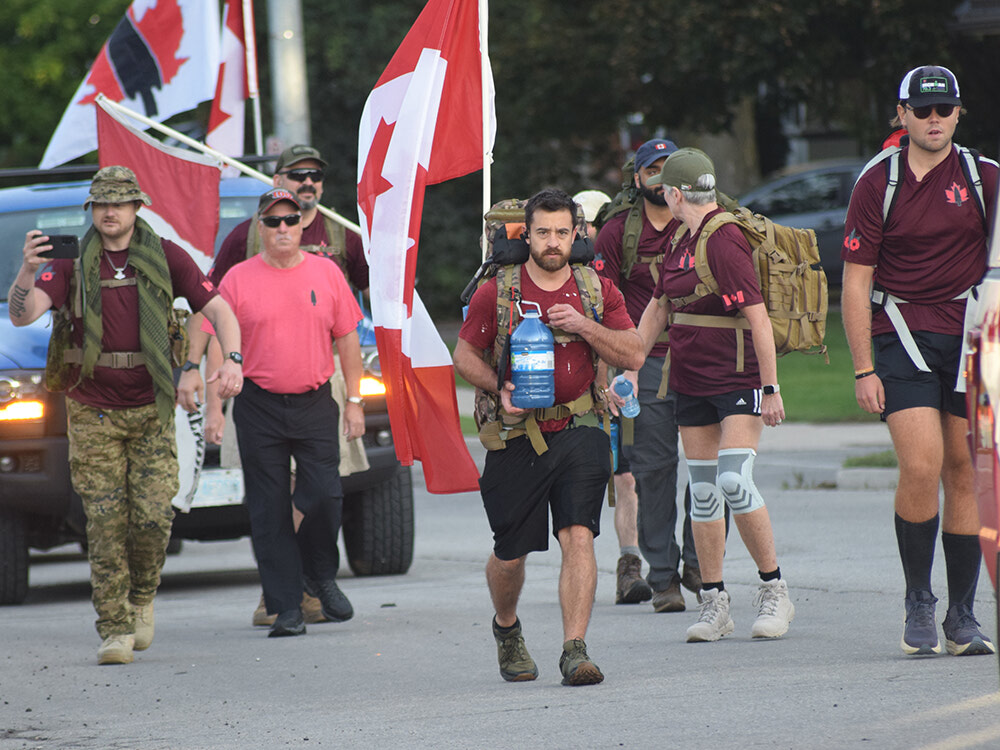
Ruck 2 Remember event begins four-day walk in Wingham
BY SCOTT STEPHENSON
The Ruck 2 Remember (R2R) march set out from Wingham last week, with participants spending four days shouldering heavy rucksacks and the memories of fallen service members. Covering between 30 and 40 kilometres a day, the walkers travelled from Wingham to Guelph to raise funds to support veterans experiencing homelessness, while drawing attention to the mental health issues affecting members of the Canadian Armed Forces.
For those who chose to walk, the packs were heavy, and the journey long, but the cause was more than worth it. At Royal Canadian Legion (RCL) Branch 180 in Wingham, Sergeant at Arms Brian Johnson made sure that the participants got started on the right foot. “You can imagine how a long rucksack march, in that time period, is going to put a lot of pressure on the individuals that are marching,” Johnson told The Citizen. “And then on top of that, they’re carrying a load of mental health stress, fatigue and the memories of the fallen. That’s a lot of load on your shoulders to be marching with, so they’re going to try to keep it light, keep it bright, work together, and be a team.”
This year, eight marchers were accompanied by a support team to take on the four-day challenge. “The whole point of doing these marches is A) to raise funds, B) to remember, and C) to challenge people to have an impact on mental health within their own communities,” he explained.
The campaign has grown substantially since it began 13 years ago, when it raised approximately $24,000. Today, the R2R raises about $150,000 annually, for a total of almost $1.2 million raised for the RCL altogether.
Brian Harris of the RCL’s Ontario Command chairs one of the programs that benefits from all that fundraising - the Legion’s “Leave the Streets Behind” initiative, which works to move veterans experiencing homelessness into permanent housing.
Harris told The Citizen that, in Ontario, this program has secured housing for 1,409 veterans - including 138 from this district alone. “We’ve expended just over $2,500,000 in support of them, and R2R is a big part of where we get the funding to help these veterans,” he said. “It started here in Ontario, and it’s now going coast to coast to coast,” Harris said. “Every RCL Command in Canada has some sort of homeless veterans response. It’s been a very successful program.”
The need is not limited to male veterans living alone. Harris said about 15 per cent of the homeless veteran population is female, while some cases involve entire families: a veteran, their spouse and their children. “The big challenge we have, of course, is finding municipalities that have affordable units that we can put these veterans in,” he said. “We work with our municipalities and other partners, and our goal is to get every veteran off the street and into permanent housing.”
Putting a roof over a veteran’s head is only the beginning for Leave the Streets Behind. “When we house someone, we don’t just put them in an apartment and walk away,” Harris pointed out. “We put them in a furnished apartment. It’s fully stocked. We make sure that there’s funding for transportation, to go to medical appointments, to peer support appointments, and any addiction counselling.” The program also connects veterans with Veterans Affairs Canada to ensure they are receiving the benefits for which they are eligible.
Harris believes that events like the R2R march raise much-needed awareness. “Along with a successful program, we have to make sure that we have more awareness,” he said. “People need to know that not all veterans are taken care of when they end their service. It seems to me that Canadians don’t fully understand or appreciate the plight of our veterans,” he said. “I don’t think the average citizen understands that a veteran is five times more likely to become homeless than anyone else you might pass on the street, simply because of the barriers they have to overcome from their service.”
For Johnson, the march is an opportunity for members of the public to reflect on the sacrifices of generations of Canadian service members. “They can sit back and look at what they have, and why they have it,” he advised. “Look at the sacrifice of World War I, World War II and Korea. Look at the sacrifice of the Somalia vets, the Afghan vets, the Rwanda vets, and all our United Nations Peacekeepers… it’s hard to know that most of them survived operations, they survived being in the theatre, they survived their wounds - but then came home without the care and the support that they needed for their mental health injuries as well as their physical injuries. It’s important for Canadians to understand that when you send a soldier into the field, you’re not just sending a man, you’re sending his family, you’re sending everything that he is into the field.”
That makes the R2R more than a long walk. It is remembrance, and a message made physical. While this year’s march is over, donations can still be made to the RCL’s R2R campaign or to Wounded Warriors, in support of Canadian veterans.