
Strome brings new era of Barmy Tech home to Brussels
BY SCOTT STEPHENSON
After more than two decades in its much-loved Walton shop, a familiar name in high-quality, locally-made fabric craft has come home to start a whole new chapter in style.
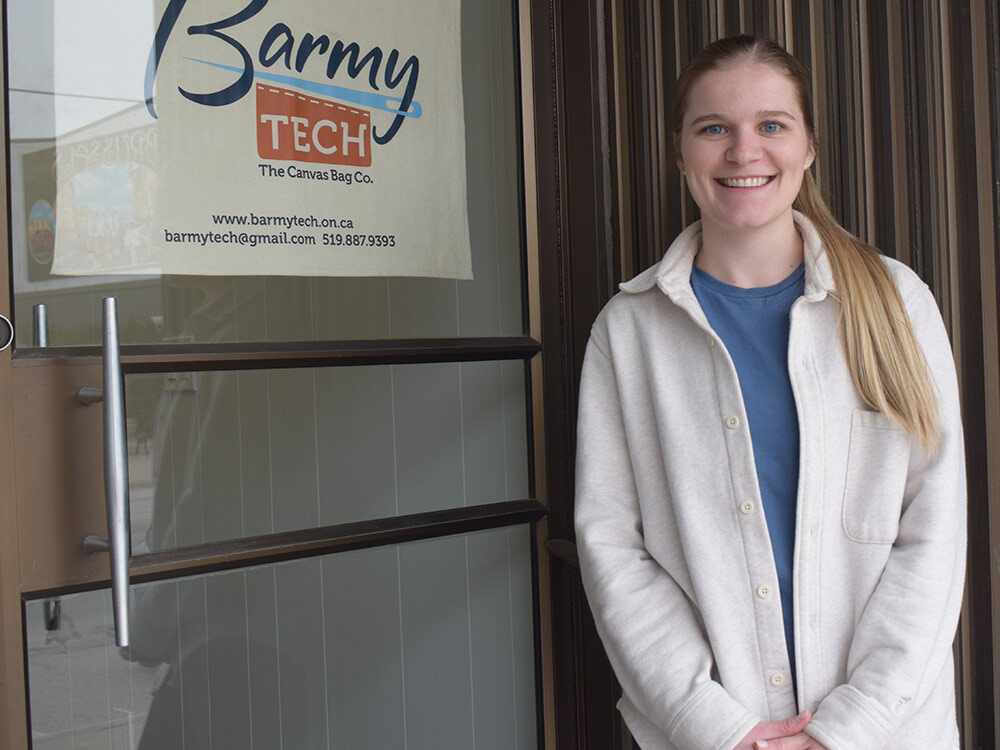
Barmy Tech - also known simply as The Canvas Bag Company - has just opened a brand new storefront in the town where it all began: Brussels. Leading this award-winning sewing business into its next chapter is Sarah Strome, a longtime Barmy Tech employee who took over from the original owner, Dorothy Cummings, a few years ago. Last week, The Citizen sat down with Strome to learn what inspired her to take the bag by the handles and leap into the leadership role of a Huron County company with a reputation for craftsmanship.
More than 30 years ago, Dorothy and her husband Robert Cummings launched their all-Canadian, custom canvas bag company from their home in Brussels by hauling all their furniture upstairs to make room for a secondhand industrial sewing machine on the main floor.
Today, Strome is still in the process of setting up her retail storefront on Turnberry Street, right next to the post office. “The Walton workshop was great - Barmy Tech had been there for 20-plus years,” Strome told The Citizen. “But Brussels definitely has a need for some love downtown! It’s nice to have a storefront on the main street and have some more visibility and walk-in traffic.”
In 1992, Dorothy and Robert started selling their original “Barmy Bag” cotton totes, which became an instant must-have for locals. The couple’s direct-to-business sales strategy quickly became a big hit with local businesses looking to promote themselves through totes and Barmy Tech eventually moved to a shop in Walton. Dorothy would go on to design Barmy Tech’s flagship bag - the “Market Tote”. The company later branched out into custom apparel and even upholstery repair.
Inside Strome’s new shop, specialized sewing machines of past and present each have their role to play in the creative process. Three vintage industrial sewing machines - reliable units that have been in use for years - handle much of the production, while newer embroidery machines add multi-coloured custom logos and designs. There’s even an ancient Singer seemingly used only to affix a tiny Canadian flag to each Barmy Tech creation.
All three of the main sewing machines found in the shop are vintage industrial units from JUKI - a Japanese company that has specialized in manufacturing top-of-the-line sewing machines since 1945. “I would definitely say JUKI the best of the best,” she asserted. “They’re about as reliable as they come. Dorothy has had them for years and years, and they really are workhorses. For sewing machines, JUKI is the way to go.”
Strome will admit that maintaining the company’s industrial sewing machines can be a challenge, particularly as fewer people work with or service them. Some older machines can no longer be repaired because replacement parts are no longer available, while newer equipment often has to be taken to specialists - likely in the Greater Toronto Area (GTA) - for servicing. Bringing in a technician can also be costly, she added. To manage, Strome has learned to handle many smaller repairs herself, relying on YouTube tutorials and troubleshooting support over the phone with service technicians, though more significant issues still require professional servicing.
While Barmy Tech was really starting to build as a brand, Strome was growing up not too far away, learning to sew. “I actually grew up just down the road from Dorothy,” she explained. “You can see her house from my parents’ house.” Her interest in sewing began early, shaped by time spent with her babysitter, who taught her to make clothes for their Cabbage Patch dolls, as well as pillows, quilts and handmade gifts. “Between her and Dorothy, the previous owner of Barmy Tech, they taught me everything I know,” she confessed. Strome started working for Barmy Tech as a summer student when she was 15. After graduating from Sheridan College in 2023, Strome took over the company and now runs most of the operation herself. She occasionally brings in subcontract workers for large orders, with additional help from family when needed.
In the March 31, 1993 issue of The Citizen, Dorothy explained that she’d been inspired to make the original Barmy Bag by a newspaper article dealing with the government's plan to introduce a personal reusable "blue bag" for shoppers. Inspired by the blue box recycling program, the idea was for shoppers to reduce waste by carting away their purchased items in the bags rather than in plastic or paper ones supplied by the stores.
What distressed Dorothy at the time was learning was that the bags purchased by the Retail Council of Canada were made in China. The feeling was that the price for a bag here was too high. "The thought that the government would go outside Canada to get these bags and didn’t appear to try hard to find a supplier in Canada troubled me," Dorothy told The Citizen back then. Dorothy ended up partnering with Brussels Village Council to create its own, Canadian-made, reusable bag campaign to raise funds for The Ark - a local not-for-profit drop-in centre for local youths.
From the very beginning, Barmy Tech has been committed to creating the highest-quality bags possible. More than three decades later, those roots remain firmly intact. “Everything is made in-house, so from start to finish,” Strome pointed out. “All bags are designed and sewn in-house, in small batches, using 100 per cent unbleached, undyed, cotton canvas… every step is done right here. “All of our materials come from Canada. We source from places like Montreal, Port Hope and the GTA.”
While all the various machines she needs to sew, embroider and otherwise create her products are already up and running, she has big plans in mind to really beef up the retail side of Barmy Tech. While custom work continues to be a major part of the business - just as it was in the 1990s - Strome wants to broaden its appeal. “A lot of what we do is made-to-order custom bags, whether it’s a logo or large wholesale quantities,” she said. “We generally have no minimums - you can order just one. You’ll get wholesale pricing at 12 or more, but we’re happy to do one-off pieces for special occasions… I’m hoping to offer more ready-to-purchase retail options,” she told The Citizen. “I’ve had a lot of people who want a bag but don’t have a logo or a business - so we’re trying to make products for them too.”
Despite the long hours, she finds the work rewarding. Strome values the flexibility and independence of being her own boss, even if the job is all-consuming. She approaches each day with a focus on doing what needs to be done while pursuing what she’s passionate about.
At its core, she sees Barmy Tech as part of something bigger than just a business. “Craftsmanship is an outlet for people to be creative,” she said. “Not everything has to be purchased at a big box store. You can support local craftsmanship and people who have a passion for creating.”
Looking ahead, Strome’s goals are simple and grounded. “In five years, I hope Barmy Tech is in a lot more people’s hands,” she said. “Seeing our products out in the community - that’s enough for me.”