
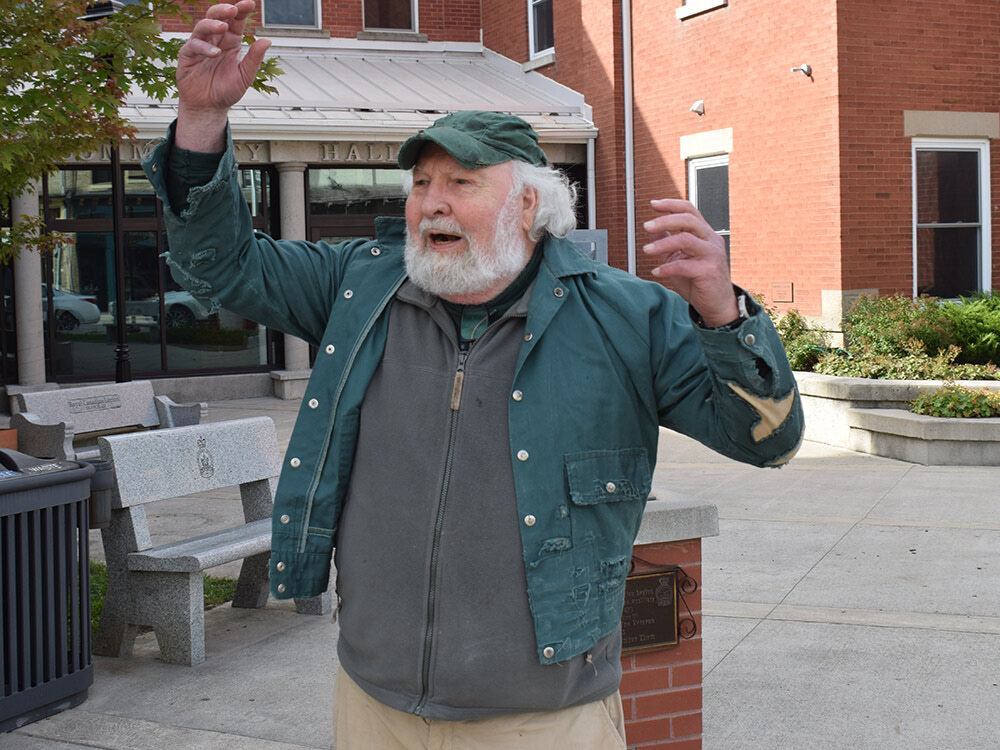
Ted Johns resurrects Aylmer Clarke (as a ghost) in new run of shows
BY SCOTT STEPHENSON
A few years ago, the Blyth Festival celebrated 50 years of rural theatre, and it seems that all that anniversary hoopla has awakened a ghost… named Aylmer Clarke.
Clarke first rose to fame as the fictional farmer featured in Ted Johns’ 1997 hit play, He Won’t Come in From the Barn. As a traditional farmer, wary of the increasingly complex web of world-wide agriculture, Clarke was a character local audiences could trust to voice shared concerns about a rapidly-changing industry. In 2002, Johns brought Clarke back to the stage for Barnboozled: He Won’t Come in From the Barn II, a play which addressed updated issues like factory farming and GMO crops.
Now, the ghost of Clarke has come a-calling once again - and he’s bringing his favourite playwright along for the ride. Johns’ latest work, the much-awaited third installment in his “Barn Trilogy”, is Aylmer’s Ghost - a self-produced one-man show that will soon be touring an unusual assortment of rural venues, from Brussels to Lucknow.
Before commencing on this unconventional theatrical tour, Johns sat down with The Citizen to discuss what drove him to hit the road with one of his most enduring characters to create an utterly unique piece of rural theatre.
This new work follows Clarke later in life, when the veil between this world and the next is thinner. “I’m sort of attracted to the idea that the dead, especially our loved ones, are still wishing they could help us,” Johns told The Citizen. “They stand around watching our daily screw-ups, and they want to be able to put their finger on the scale.”
For Johns, a character doesn’t need to die to turn into a ghost - for a set-in-his-way character like Clarke, the fading away begins when everything else moves on. “He sees his world vanish, and he sees his own role in it, where he has become a ghost, a phantasm, an imaginary thing,” he pointed out. “As we grow older, the world sort of slips away from us - this happens not only to significant people, but to all of us.”
Johns’ decision to tour Aylmer’s Ghost through smaller venues represents a return to his dramatic roots. “It comes back full circle to The Farm Show,” he told The Citizen. “That’s where my career started, touring that show through school gyms, auction barns, old theatres, little places... I just want to bring this piece to a non-theatre world - directly to the people. I expect to be addressing people not much further away than you are from me. Maybe they’ve brought their own chair to sit on. It’s a pretty direct conversation.”
Of all the stops on his rural tour, Johns is most looking forward to performing at the Crystal Palace in Mitchell. “That should be fun, because that’s my hometown,” he explained. “A huge pile of friends are really chuffed about it.”
Johns is also anticipating the show at Foster’s Farm outside of St. Marys. “It’s a huge, monstrous barn,” he noted. “I hope people come out, because it’s a really nice venue. It’s going to be a very unassuming little setup. If I had my druthers, all the performances would have been in barns. But barns have problems with chairs, liability, with toilets… There are a lot of complications.”
In lieu of barns, Aylmer’s Ghost will be stopping at a range of unique community spaces, including the Brussels Legion, Londesborough Town Hall, Hay Town Hall in Zurich, the Kingsbridge Centre and Lucknow’s HAWK Theatre.
Beyond the tour itself, Johns sees travelling with Aylmer’s Ghost at the age of 84 as part of a broader conversation about Canadian culture. “When I was growing up, there was all kinds of theatre going on, and movies and whatnot, but none of it had anything to do with Canada,” he said. “I was under the impression that nothing ever happened here.”
With works like He Won’t Come in From the Barn, Johns sought to create something that reflected the experiences of real people. “We started trying to make theatre which gave expression to people. In our case, it was rural people,” he explained. “The normal function of art was to ventilate and be a centre for public discussion of the state of affairs in that particular part of the world. People in France would go to theatres with every expectation of hearing the debates of their time enacted on stage, and I think it’s important for the health of a country to be able to discuss the issues of their day publicly.”
After decades of writing and performing, Johns recognizes the challenges involved in mounting a demanding solo production. But he also remains intrigued by what theatre can do when it brings people together, whether it be in an auditorium or a barn.
Ultimately, Johns hopes that Aylmer’s Ghost entertains, but also leaves its intimate audiences with something more than a pleasant evening out. “The best of theatre moves us to laughter,” he said. “It moves us to think about things, and carries us into another world.”
Tickets for any of Ted Johns’ upcoming performances of Aylmer’s Ghost are available through the Blyth Festival box office.