

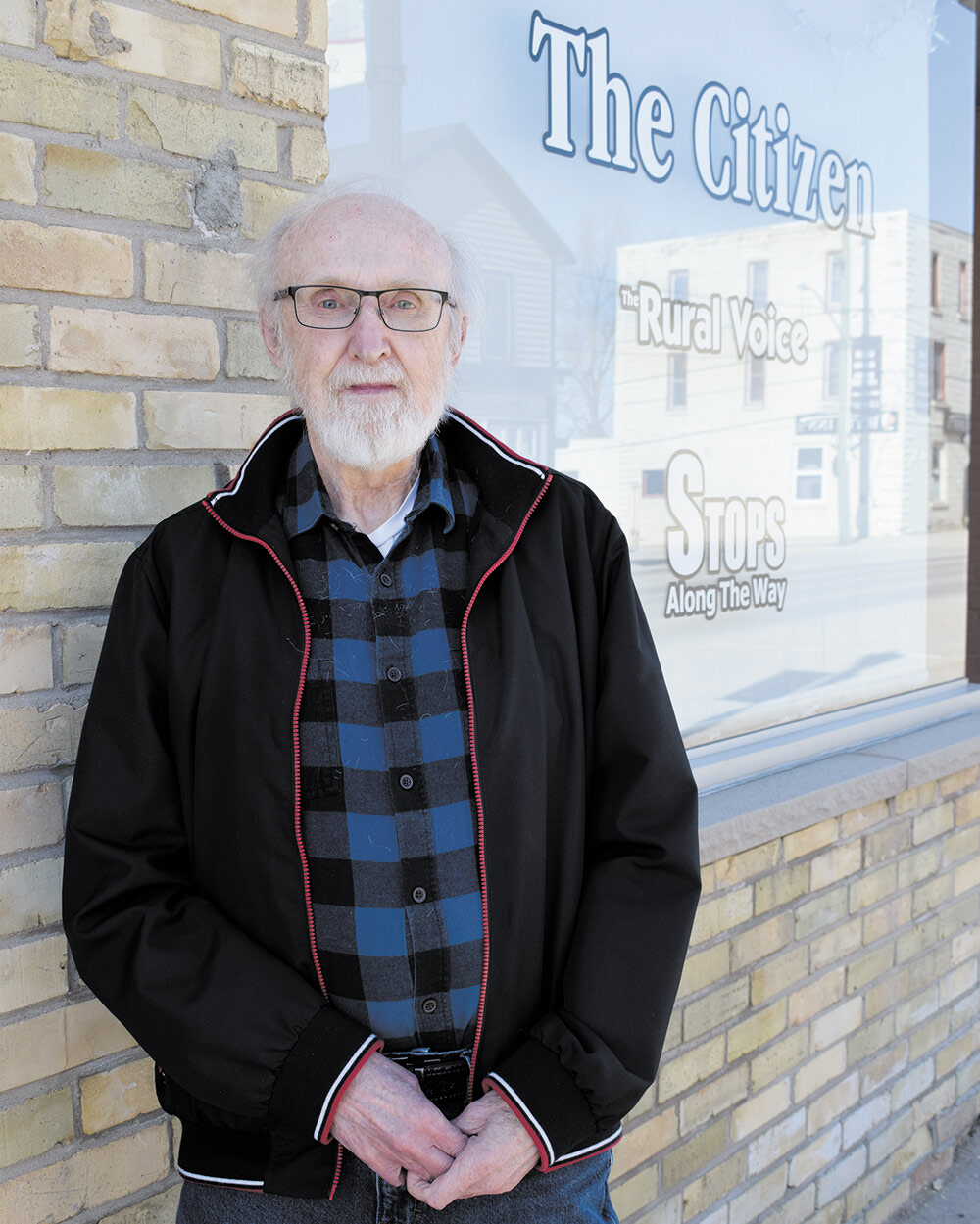
Tributes pour in after passing of founding publisher Keith Roulston
Working alongside Keith for so many years was the privilege of a lifetime. To the world, he was a dedicated newspaperman and a sharp editor, but, to me, he and Jill were the mentors who completely changed the direction of my life.
They took a chance on me over 41 years ago when I was just starting out, patiently sharing their wisdom and teaching me the trade from the ground up. I will carry his lessons, his passion for the press and his kindness with me always. My deepest condolences to Jill and the Roulston family.
Joan Caldwell has worked in production for The Citizen for more than 41 years - by far the company’s longest-tenured active employee.
I started working with Keith right out of high school in 1974 at The Blyth Standard. Both Keith and his wife Jill were kind and patient in teaching me the many jobs involved in producing a newspaper.
Keith was very dedicated to his community and determined to make sure people received the news they needed to hear. He worked incredibly long hours, attending meetings, covering fires in the middle of the night, and doing whatever was necessary to keep the community informed. I’m sure it was through watching his dedication and commitment that I learned some of the work ethic and sense of responsibility that I carry with me today.
I have a fond memory of Keith knowing that I had learned shorthand in school. One day, he sat down with me to dictate a letter. That only happened once, as he later admitted he felt rather silly doing it!
In later years, after selling the newspaper, Keith started another community-owned newspaper in 1985 called The Citizen, and I was fortunate enough to work for him again.
There is another memory that has always stayed with me. A community member once called, upset about something that had appeared in the newspaper. She felt that something had been typeset incorrectly and I took it very much to heart, feeling that I was the one who had made the mistake. Keith could see how personally I was taking it. He went out and came back with a rose for me, reassuring me that it wasn’t anything I had done and telling me not to take things so much to heart. That small gesture said so much about the caring person he was. He didn’t just look after the newspaper; he looked after the people who worked for him.
Over the years, I grew up alongside Keith and Jill. They were there as I married and started a family of my own, and they became part of so many chapters of my life. When I look back, I realize just how much of an influence Keith had on me, both professionally and personally.
He will truly be missed, but he will never be forgotten. I am still struggling to believe that he is really gone. I feel very fortunate to have had the opportunity to work with him, learn from him and share so many years and memories with him.
Rest in peace, Keith. Thank you for everything.
Dianne Josling worked in production for The Blyth Standard and The Citizen for decades, spending her entire career working with the Roulstons.
Keith was a gentle, unmistakable force - an unwavering champion for local possibilities.
It feels like Keith has been part of the village landscape for as long as I can remember. One of my earliest recollections makes me smile. It was during a snowstorm, Keith was stranded at the newspaper office and my Dad on one snowmobile, and me on another, safely delivered Keith home.
Fast forward many years, and I had the pleasure to work with Keith and a group of local stalwarts like merchants Eleanor Babcock and Bev Elliott to build the Blyth Idea Group (B.I.G.). Keith had crystal-clear ideas about how Blyth could leverage its rural food roots to create value-added opportunities. He was clear that Blyth may be small in stature, but that should not preclude “BIG” ideas. And Keith had the credibility to speak his mind: think Blyth Festival and The Citizen, two powerful, enduring success stories which defy conventional logic.
As BIG grew, so did its ambition. We enjoyed some early wins, but perhaps Keith’s greatest influence was his ability to present and share his vision in a way that was always grounded in storytelling, placemaking and authenticity.
The Blyth Idea Group evolved into Campaign 14/19, a planned five-year effort which included the multimillion-dollar refurbishment of Blyth Memorial Community Hall. While this was not even a consideration in the early days of the Blyth Idea Group, it is absolutely consistent with Keith’s willingness to concurrently embrace new opportunities (and resist change) and his genuine love of place, without losing sight of the goal: keep the journey alive.
Well done, KR. Bravo.
Steven Sparling is a retired business owner whose credits include Sparling’s Propane and Cowbell Brewing, in addition to time as a councillor and community leader.
My fondest memory of Keith comes from one, or perhaps many, of our trips together to Toronto to attend the Ontario Arts Council’s Contact. This was a mini-conference, annually held, to promote musical, theatre and children’s touring entertainment to venues across the province.
During one of our trips, the two of us started talking about “community”. I was reflecting on how, despite living in Huron County, I’d had the opportunity to meet so many interesting people, primarily thanks to my involvement with the Blyth Centre for the Arts. Keith whole-heartly agreed, that while growing up and returning to his roots, his career path within this region had offered him many opportunities.
We both had met many notable Canadians - Maureen Forrester, Gordon Pinsent, James Reaney, the Honorable Pauline McGibbon, Michael Ondaatje - all about whom we could recount interesting tales of our intersections. And, interestingly enough, all of whom felt like they were part of our Blyth community.
Of course, our conversations often covered writing - a particularly good editorial, the latest episode of “Mabel’s Grill,” or one of Keith’s plays - and community, which definitely played an important role in all of Keith’s writing. Community wasn’t merely a rural or village setting, it encompassed the ability to smile and greet everyone you met, being interested in local, provincial and federal politics and how each of those levels of government affects the region and all of its inhabitants. Community also included people, their interactions, their stories and the sense of pride we all feel when someone local succeeds, contributes or works together on events.
Often with community, there comes collaboration, and that was also evident in Keith’s work on the paper, The Rural Voice, The Village Squire and the Blyth Festival. Keith had a way of making one believe that you could do the impossible, after all, he lived that - founding a nationally-recognized theatre, starting a publishing company, and an award-winning newspaper, as well as being a published playwright.
His plays often found their way into those driving conversations, and it is why I believe that community and collaboration go hand-in-hand. Once, when talking about how his play, written with Anne Chislett, Another Season’s Promise, was being produced in Edmonton at The Citadel, Keith said that the only reason he wrote plays was because the Blyth Festival provided him the opportunity to do so. He liked writing about the people, our issues and the stories that mattered to us because we saw ourselves reflected on stage.
On another trip, I piped up that I’d never forget one of his lines from the play, Jobs, Jobs, Jobs where Anne Anglin’s character shouted, “There you go, Cheeze Whiz!” Keith got quiet, and said that was one line he didn’t originally write into the play; Anne stated it during rehearsal, it stuck and he wrote it into the script. This was when I realized that it wasn’t just community that made Keith such a special man, but how he recognized, encouraged and honoured collaboration.
By acknowledging our roots, our community and working with others, we can achieve so much more than focusing just on ourselves. This was a life-long trait that followed Keith on his life’s journey, and one from which we can all learn so much.
Marian Doucette is a long-time Blyth Festival Board of Directors member, former president and a shareholder of North Huron Publishing and a member of its Board of Directors.
First of all, our heartfelt sympathy to Keith’s large and loving family.
I’ve been in the newspaper industry since 1967 and have met a lot of newspaper proprietors during that time. Keith stands out as a colleague in a rural newspaper setting, similar to many of us.
Where he really stands out is as a newspaper proprietor who was also a man of letters and the wonderful tribute published in The Citizen really highlighted this fact.
He was not only a wonderfully learned man, but a practical one who did a great deal towards reinventing his chosen home town as a cultural centre, not merely in Southwestern Ontario, but in our province.
We always found him kind and collegial and, in many ways, a throwback to individuals in our industry who understood at a fundamental level that, as a respected voice in their community, they, and their publication, were perfectly positioned to do good things.
Keith was the individual many of us aspired to be - a true role model. He understood what power he had his fingers on locally and he made use of it for the common good.
Blyth and area are the richer for Keith Roulston. A pretty nice legacy.
Rick McCutcheon - retired publisher, The Manitoulin Expositor
How do you tell the story of Keith Roulston? Well, look at what Shawn and the rest of The Citizen staff have done in recent weeks. There is no way I could do better, not that I’d try, but every page that had anything to do with Keith was what I will forever now think of as a masterclass in respect for a career journalist after they are gone.
With Keith’s passing, the community I have come to call home has lost one of its most stalwart defenders against obscurity. Keith (and Jill, of course) and the people they have trained, inspired and touched over the years have created institutions that I pray will last for decades and more.
North Huron Publishing, which I will shorthand to The Citizen, of course is a beloved community newspaper where I learned most of what allowed me to feel comfortable moving into an editor position elsewhere. However, what readers may not know is that this is, in my opinion, the blueprint for community journalism - for the community, owned by the community and supported by the community - and that is primarily due to Keith’s vision and drive.
The Blyth Festival, as everyone who has passed through the doors to the theatre (or down the path to the Harvest Stage) is Canadian theatre. Full stop. And without Keith, I don’t know that it would be there.
For those who didn’t share an office with Keith every day - and therefore didn’t come in to find a note of congratulations or correction on their desk - his impact would likely seem like that of a giant. However, I will always remember him as the man surrounded by publications.
That isn’t a metaphor. While North Huron Publishing has recently returned to the offices it inhabited for years, the place looks a lot different from the first time I made my way to the village with hopes of continuing to be a journalist.
I didn’t know then who Keith was, or what he had accomplished. All I knew was that my first foray into journalism was coming to an end and my then-publisher had connected me with Keith as a chance to keep doing what I had dreamed of doing.
I don’t know why, but I will always remember the day I interviewed. Walking into the office, which I’ll always remember as being awash in yellow with traditional light bulbs - a stark difference from the clean white angles of the renovated space - and then into Keith’s own space, was an experience. Keith’s office was stacked high with what could have been every publication he’d ever put his name to. I won’t beat around the bush: there was a moment when I wondered if the walls were just piled magazines and newspapers.
I took off my overly warm leather jacket and handed Keith my photography portfolio and my much leaner writing portfolio and, after a short discussion, I was being introduced to the rest of the team behind The Citizen, The Rural Voice and Stops Along The Way. It was a whirlwind of a day and you likely could’ve pushed me over with a feather if you told me the man behind stacks of publications was the architect of the how-to guide for creating a community publishing company, let alone the impact he had on Canadian theatre and the Blyth Festival.
Keith took a chance on me: a kid who had less than two years’ experience in a real newsroom, no formal journalism education and, aside from a camera and a new car, really nothing going for me that could’ve put me ahead of anyone else who may have applied. And my life was never the same as a result. And is that not the measure by which we all wish to be remembered? The way we changed other’s lives for the better? Everyone in Blyth, the communities covered by North Huron Publishing, and a good number of those involved in national theatre have been touched by the efforts of Keith (and Jill) whether they know it or not, and we all owe both thanks for that.
A friend messaged me after news of Keith’s passing, offering condolences. I’ll end here with what I told her: Keith was one of a kind and likely a big part of why I’m still making a living in journalism. I hope that meant as much to him as it means to me.
Denny Scott, editor, Midwestern Newspapers, former reporter at The Citizen
There are people who contribute to a community, and there are people who help define what that community becomes. Keith Roulston belonged firmly in the latter category.
Keith’s passing has prompted many well-deserved reflections on his contributions to journalism, theatre and life in Huron County. Through The Citizen, The Rural Voice and the Blyth Festival, he helped create and sustain institutions that have enriched our communities for decades. Yet for me, his greatest contribution was perhaps something less tangible: he helped us recognize the value of rural life, the importance of community and the responsibilities we share for shaping our collective future.
I grew up on a farm in East Wawanosh, not far from the farmhouse where Keith and Jill lived for so many years. Although our paths through life were different, we shared a deep affection for the countryside and the people who make it home. We also shared a belief that rural communities have something important to contribute to the larger Canadian story.
When I began my career as a planner in Huron County, Keith was already a veteran newspaperman. Planning often involves issues that generate considerable public debate and, at times, controversy. What I remember particularly well was Keith’s fairness in reporting, his commitment to accuracy and his willingness to understand the complexities of an issue before drawing conclusions.
I never expected special treatment because we were part of the same community, nor would Keith have offered it. Rather, there was a commitment to accountability, informed discussion and helping readers understand the issues affecting their lives. I respected him enormously for that.
I also admired his editorial voice. I always looked forward to reading his editorials in The Citizen. They were thoughtful, informed and principled. He had a remarkable ability to take an issue of local importance and place it in a much broader context. His observations were every bit as insightful as those in major city or national newspapers, and often more grounded in the everyday lives of the people affected.
Keith was never afraid to challenge those in positions of authority, question accepted wisdom or ask difficult questions. He certainly had opinions, and occasionally used a pointed observation or a touch of humour to make his case, but there was a fundamental fairness in how he approached issues and people. He cared about getting things right, even when doing so might not please everyone.
Keith also had a deep affection for Canada. I remember more than one editorial in which he compared some aspect of Canadian life with that of our neighbours to the south, reminding us how fortunate we are to live in this country. It wasn’t blind patriotism or boosterism. It was Keith, with his characteristic fairness and common sense, reminding us of the values and institutions worth appreciating and protecting.
His understanding of and empathy for agriculture were particularly important. Keith appreciated the challenges facing farm families, the changing nature of the industry and its essential contribution to Canada’s prosperity. He understood farming not simply as an economic activity, but as a way of life intertwined with families, landscapes and communities. Through The Rural Voice and his other writing, he helped ensure those perspectives were heard.
In the summer of 2025, my wife Deborah and I attended the Blyth Festival’s revival of Keith’s play Powers and Gloria. We found it funny, moving, dramatic and remarkably thoughtful. Looking back, I recognize how much of Keith himself was reflected in that play. It was about people caring for people, the power of individuals to make a difference and the responsibilities we have to one another. Beneath the humour was a serious reflection on the choices we make and the values that guide them.
In many ways, the play captured how Keith saw the world: optimistically, pragmatically and with a deep belief in people and community. He appreciated the diversity of the small towns, farming communities, fishing villages, forestry towns and Indigenous communities that are such an important part of Canada’s identity.
The Blyth Festival itself is an enduring expression of that belief. Helping establish professional theatre in a small rural village required imagination and confidence in the value of rural stories. Keith knew those stories deserved to be told, and that they could resonate far beyond Huron County.
Of course, Keith’s accomplishments were not his alone. Jill was his partner in life and in so much of what they built together. Their shared commitment to publishing, family and community was an important part of his story, and one that deserves recognition and gratitude.
Beyond these accomplishments, I will remember Keith as a kind, thoughtful and caring man. He embodied many of the values I learned from my parents, teachers and neighbours growing up in East Wawanosh: honesty, fairness, generosity, respect for others and a willingness to contribute. He was principled without losing his humanity, knowledgeable without needing to impress and deeply committed to the community that he helped make stronger.
Keith’s legacy will endure well beyond the years of his own contributions. It lives in the institutions he helped build, the people he influenced and the example he set for others. It will continue through those people, their children and their children’s children.
For that, our community - and rural Ontario, indeed rural Canada more broadly - owes him a great deal.
Wayne Caldwell, PhD
Professor Emeritus (OAC), Rural Planning and Development
University of Guelph
By the mid 1980s, Keith had delighted audiences with his lighthearted, affectionate and oh-so recognizable comedies of village life. Then, suddenly, there came a crisis in agriculture.
As a newspaper editor, he published analyses of the economic issues, advertisements for forced farm auctions and, with them, obituaries that he knew in his heart were related. In Another Season’s Promise, Keith as a playwright revealed what the journalist could not: the farmer’s raw emotion, the devastating struggles and the passionate determination to survive.
Working with Keith on this play was a highlight of my career.
(Over the years at the Blyth Festival, Keith had the following plays produced: The Shortest Distance Between Two Points (1977), His Own Boss (1978), McGillicuddy’s Lost Weekend (1979), Fire on Ice (1981 - a collective creation based on one of Keith’s original scripts), Another Season’s Promise (1986, with Anne Chislett), Jobs, Jobs, Jobs (1998), McGillicuddy (2001), Powers and Gloria (2005, remounted in 2025) and Another Season’s Harvest (2006, with Anne Chislett).)
Anne Chislett, co-founder of the Blyth Festival, former Artistic Director and Governor General’s Award-winning playwright.
When I first met Keith in 1975 to present him with the idea of starting a professional theatre in the Memorial Hall in three months’ time, he didn’t say, “That’s an outlandish idea!” Instead, he quietly responded, “yes” and he would help.
And help he did, from taking the lead on setting up a Board of Directors, to serving as the first Chair of the Board, to aiding the tiny first-year staff in finding show props. Only after the successful opening night of Mostly in Clover did he confess to having been “a little nervous” about the whole thing.
He had never betrayed that feeling to me; all I saw was his quiet determination, a quality that I came to recognize many times in Keith over the years as he made decisions that bettered his community.
In the Huron Historical Society’s video interview with Lisa LaFlamme that was reshown recently in the Memorial Hall, she asks Keith what he thought the headline of his life should be. Typically understated again, Keith answers simply “He Did It”. Yes, he certainly “did it” to the benefit of us all!
James Roy, co-founder of the Blyth Festival
Keith Roulston might have been the most principled person I’ve ever known. Without Keith, and his principles, I think it’s very unlikely the Blyth Festival would be here today.
Keith was one of the Festival’s founders. Legend has it that Keith had been in attendance at the very first performance of The Farm Show in Ray Bird’s barn, sitting beside James Roy, and the two of them had their minds lit like bright filaments of inspiration by what they saw… and they turned that blazing new light toward the essentially condemned old Blyth Memorial Community Hall, and from that new flame the Festival was ignited.
Keith saw something in The Farm Show that wholly aligned with his principles: a play that put local people front and centre… not just in the audience, and not just on stage, but in the heart of the work itself. In the story. In the story itself. In the portraits being painted by these professional actors, surrounded on all sides by neighbours, and a few hundred bales of hay.
It’s a romantic vision.
And it’s true.
But it doesn’t capture even the half of it.
Fact is, saving Memorial Hall, and getting the Festival started took a lot more than an inspired light bulb in the head. Memorial Hall wasn’t remotely in the condition it is today. By the end of the 1960s, the roof was falling in, and the upper parts of the outer walls were bowed out, bricks pulling away. No one was allowed upstairs in the auditorium. (When The Farm Show actors came around and tried to use it to rehearse their next show, 1837: The Farmers’ Revolt, the town council at the time made them all sign waivers that if the roof fell on their heads they wouldn’t sue.) Story goes, the Village Council planned to demolish it.
Keith pounded the pavement. He rounded up volunteers. He got local folks to pledge donations. He gathered enough people to the cause of starting this Festival, that they could incorporate, sign the letters patent, and even got a lawyer to notarize and seal it all (and turn around and donate the service). And he convinced the council that they should act to restore the hall, take funds from their budget, and use them to roll the dice on an unimaginable risk: a festival of Canadian plays.
Keith didn’t do it with a bullhorn in his hand, or by decree to a fleet of staff. He did it one conversation at a time. Knocking on doors. Picking up the phone. Holding town meetings. Writing letters to the editor. Putting up posters. He did it by grit and determination. And he did it until it was done.
Keith served as the Festival’s first general manager (a role he reprised several times over the years when the company needed him), he served on the Board of Directors, he sat on the Finance Committee, he volunteered for fundraising auctions, he wrote grant applications, he called local businesses and tried to get them to be sponsors, he sold tickets at the counter, he stuffed envelopes, he answered the phones, fed countless new ribbons into cranky typewriters, ran the gestetner, personally photographed all of the shows for publicity shots, and, speaking from personal experience, I will bet you he also washed dishes, stacked chairs and cleaned toilets.
I imagine that only his wife Jill could really tell us, with any accuracy, just how many years of the man’s life were given over, hour by hour by hour, to the Blyth Festival.
And it wasn’t only that day-to-day grunt work. Somehow, in the midst of all of that (and raising a family, and running this very newspaper) he also found time to find his voice as an artist in his own right. Keith was one of the most produced playwrights on the Blyth stage. Between 1977 and 2006 he wrote nine plays. Two of those he wrote with the Governor’s General Award winner (and another founder) Anne Chislett: Another Season’s Promise, and its sequel Another Season’s Harvest. The other seven plays were pure Keith: The Shortest Distance Between Two Points, His Own Boss, McGillicuddy’s Lost Weekend, Fire On Ice, Jobs, Jobs, Jobs, McGillicuddy and Powers and Gloria (which we produced afresh in a stunning revival in 2025). And the truth is, he wrote even more plays than that… those are just the ones that finally made it to the stage.
I had the privilege of working directly with Keith on his plays twice: as an actor in the original production of Powers and Gloria, and as a director on Another Season’s Harvest. There was never a moment working on either of those shows where I ever had to wonder what Keith stood for. Principled.
I didn’t always see eye-to-eye with Keith. He could be critical of me, and I could be critical of him. I wouldn’t say we ever really fought… but we certainly disagreed with each other more than once. We both served the same institution for decades alongside each other in some capacity or other and, whatever our differences, I can say two things: he was still always good for a laugh at the Finance Committee table (not always the easiest place to find a chuckle), and he never stopped contributing new ideas... whenever he came across some striking piece of local history, or wild local headline, he would always send them my way… you never know what might light up that filament in a playwright’s mind. He never took his shoulder off the task… we were still pulling in the same direction.
In many ways, the Blyth Festival is a testament to what Keith was trying to build: something genuine, handmade, locally-sourced and, maybe above all, durable.
Durable cultural institutions are a rarity in this country. We are all so much richer for having this one.
And we can’t take it for granted. It’s not here by accident, or because of luck or happenstance. It’s here because of hard work, and the kind of commitment to community so many of us believe in, but too few roll up our sleeves to act on.
Let’s honour Keith by following his example, and keep it going.
I don’t know the secret to making a cultural institution endure… but what I can tell you is that it sure helps to have solid guiding principles.
Gil Garratt is an award-winning actor, accomplished playwright and the Artistic Director of the Blyth Festival.
Keith Roulston was a storyteller. He wrote them, he told them, he listened to them; he brought them forward inside the newspaper, the magazine, and on stage. Inside each story was the heart of the matter - something that needed getting at. The stories could entertain, bring enjoyment and often grew from an unanswered question about community.
Keith was a builder; a collaborator. From him and Jill making a family on the farm, to them both bringing us The Citizen and The Rural Voice. Keith was a visionary - one of the founders of the Blyth Centre for the Arts, a location that has connected artists to audiences across the planet and it always appealed to his storytelling heart. He brought forward the Blyth Idea Group with regular meetings where the assembled jammed on about what could be next that might aid the health of the community.
Keith was a friend. He was hard-working. And for those who knew him, there are so many experiences, encounters, while in his company, that are unforgettable. Here are two from my top 10 list.
He and Anne Chislett co-wrote Another Season’s Promise for the 1986 season at the Festival. On opening night - the house, full to overflowing - David Fox as Ken Purves, the lead in this remarkable stage experience, brought forth dignity, energy and stick-to-it-iveness in the playing of his character.
As the play led us toward the tragic finale of how a once successful farmer falls from grace - the room had gone stone quiet. We watched in horror as Fox, as Purves, became unhinged with his grief while his wife, played by Araby Lockhart, did her best to calm him. It was powerful and was a story that was going on in the fields and farms right outside the theatre. I’ve sat in many halls, and performed in many more, and without hesitation I can say that experience that night in Blyth, was one of the most moving cases of truth-telling I’ve ever witnessed.
As we gathered in the lower hall for the post-show party, a local farmer came up to me and said: “I’m really glad you did that show. But I never want to see it again.” For me, that was one of the finest reviews a play could’ve received. And it was because Keith and Anne brought the story forward - an essential conversation, a truth unfolding right outside the door.
There was a while where Keith and I would grab a lunch now and then. Our conversations were pretty free-form, traveling from the local to the international. They involved politics, art, stories about our families, some gossip tossed in. We’d eat at The Boot mostly, but sometimes at Part II Bistro or the Queens Bakery or out at the highway gas station diner. At one of the luncheons Keith said, “wouldn’t it be great if rural people could talk to rural people about what was going on in their community, rather than be told what was going on by someone from Toronto?” And from that lunch, and that comment, Rural Talks to Rural came into being.
He was at every R2R right up to R2R24 that happened in Memorial Hall in Blyth. He was invited to come to Newfoundland for Shore2Shore in 2026, but he had to decline as he was dealing with some health issues.
It’s sad he’s gone. He is missed by all of us who knew him, who cherished his wisdom. But as I stumble forward, in situations where I’m not sure what I should do next, I’ll ask this question: What would Keith Roulston do?
RIP good man.
Peter Smith, former Blyth Festival Artistic Director, playwright
Keith Roulston is one of those people whose legacy will be greater in his memory than was his presence in life.
In life, he was a determined, yet humble man. But his cultivation of and celebration of the richness of life in a small town leaves a legacy of accomplishment that will grow larger as the years pass.
The last time I talked to Keith it was in a Zoom conversation with him, James Roy and myself in November of 2021. The three of us were looking back to the beginning of the Blyth Festival 50 years earlier. The three of us looked back to the sparks of that beginning. Through that conversation Keith and James marvelled at their youthful naivety as they reached out to create that first season, and I, as a broadcaster, recalled seizing on the chance to tell the story.
But Keith was much more than the Festival, as important an institution as it is. Keith did so much more than write about what was happening - he instigated programs and activities that celebrated and added to the social and economic fabric of Blyth and Huron Country.
Besides our recollection of those heady days in the beginning of the Festival, we asked Keith if he was still writing. He responded that he had written a play, a novel and that he was working on a book to document the beginnings of the Festival.
In all of his writing, Keith documented, defended and celebrated the people and the lifestyle of life in small towns. And now in his wake we celebrate his vision and his conviction that small towns offer big opportunities.
Jim Swan, retired broadcaster with over 40 years of experience and the Voice of the Barn Dance
I don’t remember Keith Roulston ever losing his temper. He was the most even-keeled, unassuming and unspoken hero of rural Ontario journalism.
Keith always had a story at the ready when you met him. Quietly insightful, he would untie a problem facing us all in about one or two sentences of a good newspaper lede/lead or in conversation when you randomly met him.
Keith led his own quiet revolution in rural Ontario journalism and theatre during active and turbulent times of the early 1970s. I saw him as an incredibly resilient and true Renaissance Man of Letters. I will miss Keith’s dry wit, gift of sharing stories, optimism in a challenging world and hearing his voice and seeing his knowing grin. I was always left smiling after talking with Keith. He will be, and is already, greatly missed.
He was an inspiration and will continue to be for future generations.
David Scott, who served with Keith for six years on Blyth Festival Board of Directors, a fellow local journalist who got his first summer job at the Huron Expositor in Seaforth - where he was later a reporter and editor - and fellow playwright.
The Huron Pioneer Threshers and Hobby Association Inc. was truly honoured and fortunate to have Keith and his dedicated staff covering our annual reunion and yearly events.
Keith grew up on a farm, he appreciated his rural heritage, agricultural history and enjoyed observing all the working exhibits. He enjoyed listening to stories, past and present, studying the working displays and capturing the moment with his camera. The threshing machine reminded him of his boyhood days, growing up on the family farm, work bees and the gathering of families, sharing “threshers meals”.
Our club invited Keith to be the guest speaker at our annual church service in 2024. His message, “The miracles of agriculture”, was so inspiring!
Word quickly spread around the grounds and out in the community about his sermon at the church service. Soon after, The Citizen received many requests to print Keith’s message for all to read. A very proud moment for Keith and our club.
What a great legacy you have left for our community! Thank you!
Marian Hallahan was, for decades, the secretary of the Huron Pioneer Thresher and Hobby Association, where she continues to volunteer to this day.
I was very saddened and shocked when I opened my paper issue on Nov. 6 to read of Keith’s passing.
I always went to his column first and enjoyed his words so much and felt as if we were good friends although, sadly, we never met.
My deep sympathies to his wife and family. We, his readers, will miss him terribly. In these times, he was a ray of sunshine and you felt that all will be okay.
Thank you Keith for your inspiring and hopeful words each week.
Lorraine Frymire
RR1, Walton.
I feel a sense of loss with Keith’s passing. He gave so much to the community and our culture, by his newspaper and magazine publication efforts, and with his huge contribution to live theatre. His newspaper and The Rural Voice magazine columns were insightful without being tedious. Just a good amount of observation of events, issues or personalities - whether local, national or beyond in the wider world.
Reflection is what he gave us, and suggested to us for consideration. The overall point was community understanding. And a bent toward decent behaviour, from individuals, an organization or a political regime. Communication was the essence of all his work - reports, editorials, columns and plays.
We should take his nudge in our daily lives. Everybody, behave. Get along together. Work for the good.
Thank you, Keth Roulston. For your ideas, and your inspiration.
Reg Thompson, local librarian and historian
I am a writer, editor and proofreader, now mostly retired, but I was only a young writer starting out when I did a work term with Keith at The Rural Voice. He assigned me a big topic back in 1994, when the internet was just getting going. He wanted me to look at the impact on farmers and what might be coming as far as computers and the future of farming. I used a blueprint format from Writer’s Digest magazine to write the piece, and I think Keith was as thrilled as I was when it won the North American-wide Writer’s Digest contest for article writing.
Keith was so generous with his time and encouragement, and I learned so much during my short work term at his magazine. Because of that, and the recognition from Writer’s Digest, I was able to make writing and editing my entire career. I have always been very grateful to Keith for that start.
Attached are some pictures from winning the contest back in 1994. Writer’s Digest used clips from the work-in-progress to teach other writers how to use their approach.
RIP, Keith.
Corinne Robertson-Brown, writer, editor, proofreader
While reflecting on Keith, I think of him as a kind man; one who knew no enemies. He was a great neighbour and a true friend and I would like to take this opportunity to share a comical memory that I have of Keith of which few others would be aware.
Quite a few years ago, Keith decided that it would be advantageous for his family if he could raise a few pigs until they would be ready for his freezer. As the summer advanced, the pigs grew bigger and bigger and became more difficult to contain, until one morning when he awoke and the pigs were gone.
With all the fields around his property being covered in tall corn, it was impossible to go looking for them until, a few days later, they appeared on our front lawn, about a mile away from where they had escaped.
With due diligence and language only used while capturing pigs, Keith, my wife Evelyn and I managed to corral them into a chicken coop we had available.
So, for the next four weeks, Keith would stop in every morning on his way to work and feed them until arrangements were made to take them to the local abattoir.
I’m not sure of the exact final result, but I do know that it put an end to Keith and his “swine herd”.
Thanks, Keith, for the memories.
Leslie and Evelyn Caldwell are farmers who live just north of Blyth and long-time friends of the Roulstons.